
This page walks you through the team lead's tasks: preparing your team, starting the first cycle, inviting members, importing their work, editing the main project, and starting a new cycle or finishing the project.
Prepare your team project
What you need
- TeamCloud license: your TeamCloud license is activated in your MAXQDA Account. See how to get and activate a TeamCloud license.
- Logged in: you are logged in to your MAXQDA Account in MAXQDA.
- Team members' accounts: everyone you plan to invite by email has created and verified a MAXQDA Account. People without an account can join with an invitation link instead (see Step 2).
- Enough storage space: each team member stores the complete project on their own computer, including external files such as videos. Make sure everyone has enough free space, especially for large media files.
Agree on how your team works
In TeamCloud, each person works on their own copy of the project on their own computer, and you bring everyone's work together in the main project when you import it. The import follows fixed rules. Agreeing on the following points before Cycle 1 helps everyone's work arrive the way you expect.
- Choose a suitable method: TeamCloud works best when the code system is set before the analysis starts, as in deductive coding. Open or inductive coding and grounded theory change the code system throughout the analysis. Since team members' renamed or moved codes arrive as new codes, plan in that case how code changes reach you, and expect more cleanup after each import.
- Know the import rules: make sure everyone, including you, has read the four import rules before Cycle 1. Changes that look normal in MAXQDA are often not imported the way people expect.
- Changes to the code system: decide that only you, as team lead, rename, move, merge, or delete codes. Team members' renamed or moved codes arrive as new codes, and their deletions are not imported. Agree on how members suggest changes instead, for example in the project logbook.
- Divide the work: assign documents, codes, or both to team members to reduce conflicts when you import their work. If two people edit the same memo, summary, or coded segment in a cycle, usually only the most recent edit is imported.
- Meaningful names: give new documents, free memos, QTT worksheets, summary tables, and MAXMaps concept maps descriptive names. Generic names increase the risk of naming conflicts during import. A new document with the same name and position in the Document System as an existing one is not imported.
- Shared working rules: agree on how to flag uncertain codings, what memo labels mean, and which colors to use for new codes.
- Upload deadline: agree on a deadline for members to upload their final work for each cycle. Ask them not to upload again after that deadline without telling you.
Step 1: Upload your project and start Cycle 1
To share a project with your team, upload it from MAXQDA. This converts it into a TeamCloud project. Ideally, the project already contains all your data and the code system your team agreed on.
- Open the regular MAXQDA project you want to share with your team.
- In the TeamCloud menu, click Upload Project for Team (Start Cycle 1).
- In the upload dialog, enter a project name and notes for your team. Both fields are required.
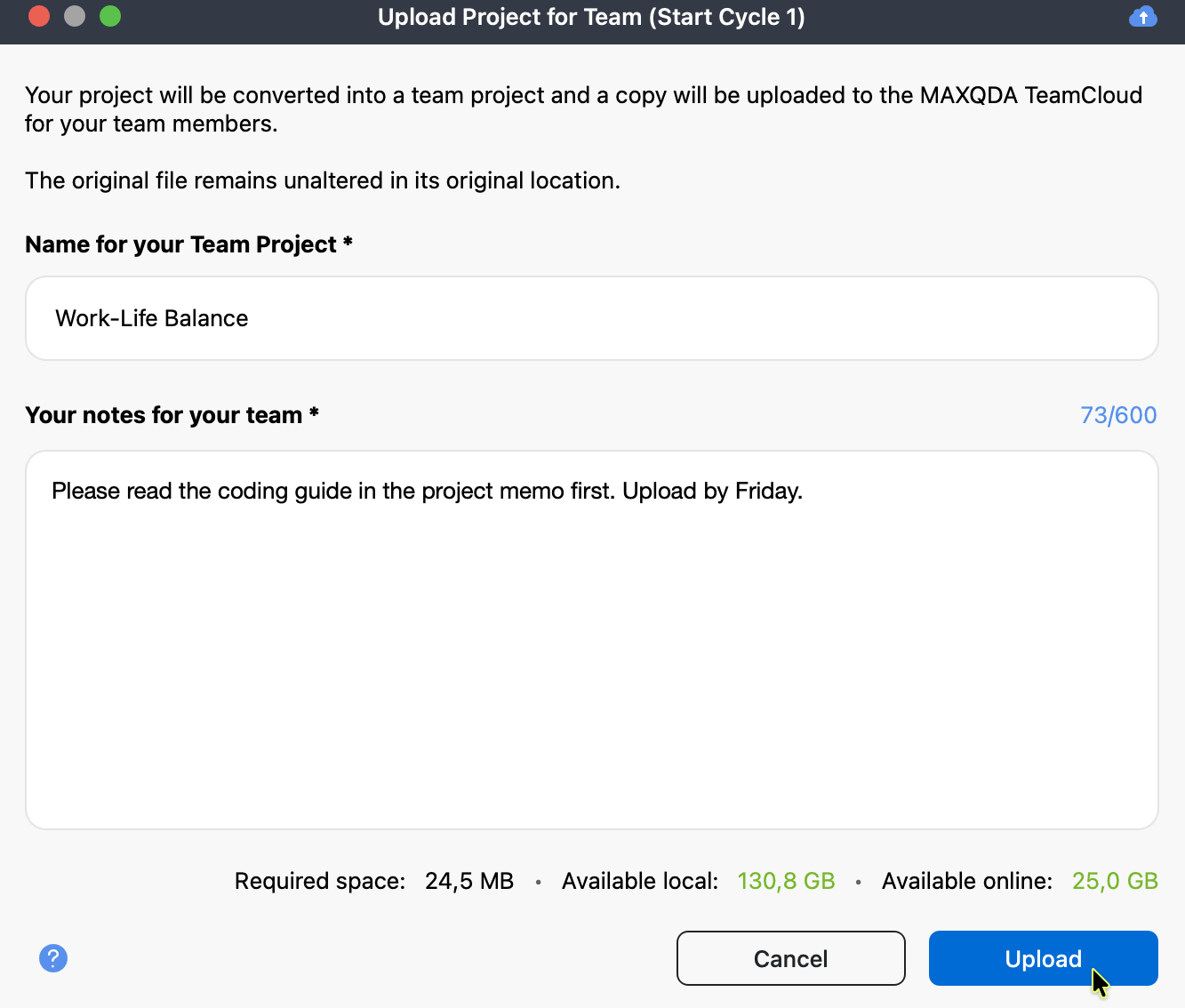
- Project names must be between 3 and 63 characters.
- Notes can be up to 600 characters. A counter shows how many you have used.
- The dialog shows how much storage space the project needs and how much is available on your computer and online. The figures appear in green when there is enough space and red when there is not.
- Click Upload. The button becomes available once both fields are filled in. A progress bar tracks the conversion.
If the upload fails because your internet connection is lost, MAXQDA retries automatically. If the retry fails, start the upload again manually.
When the upload finishes, MAXQDA confirms that Cycle 1 has started. Team members can then download the project.
After the upload, your new TeamCloud project is open in MAXQDA. The original project file remains in its previous location, but any changes you make to it will not reach your team. Work only in the TeamCloud project, and open it from the Team Projects tab in the welcome screen or via TeamCloud > Open Team Project. You can recognize it by the window title, which starts with "TeamCloud project:" and shows the current cycle. If you have already worked in the original file, see how to bring that work back into TeamCloud.
As team lead, your TeamCloud menu has Upload Project for Team (Start Cycle N) and Import Team Members' Files. Team members see Upload Project for Team Lead instead.

Step 2: Invite team members (on the TeamCloud website)
Use the TeamCloud website in your browser to invite team members. You cannot send invitations from MAXQDA.
To invite someone by email, they need a verified MAXQDA Account first. If they do not have one, ask them to create one or share an invitation link instead. Creating an account is free and does not require a TeamCloud license.
Once you have uploaded the project, MAXQDA prompts you to invite team members. Click Invite team members. The project's Members tab opens on the TeamCloud website in your browser. If necessary, log in to your MAXQDA Account first.
On the project page, click + Invite project members. You can invite people in two ways.
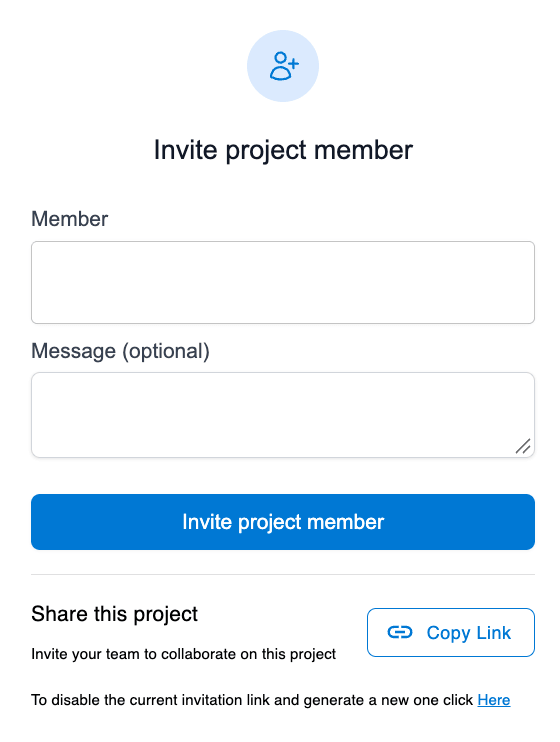
Invite by email
- In Member, enter the person's email address.
- Optionally add a message, then send the invitation.
- Repeat these steps for each team member.
If an error with the number 3003 appears, the person does not have a MAXQDA Account yet. Ask them to create one, or share an invitation link instead.
Each person receives an invitation email. They first accept the invitation by clicking the confirmation button in that email. They can then download the project directly in MAXQDA and start working.
Share an invitation link
Use an invitation link for someone who does not yet have a MAXQDA Account. They can create one when they open the link.
- In the Share this project section, click Copy Link.
- Send the link to your team members, for example by email.
When someone opens the link, they log in to their MAXQDA Account, or create and verify an account first. They then join the project as a team member.
Anyone with the link can join the project. Share it only with your team. To stop the current link from working, click Here below Copy Link. This generates a new link.
Whether people join by email invitation or shared link, you receive an email and a notification in MAXQDA. The project's Recent Activity section on the TeamCloud website also records the event. You can invite or remove members at any time, not only at the start of the project.
Everyone in your projects, including you, occupies one seat of your TeamCloud license. To see who occupies your seats, open the Seats Overview at teamcloud.maxqda.com/team/ while logged in. Clicking Remove next to a person takes them out of your projects and frees their seat. To take someone out of a single project only, use their member tile, as described below.
Removing a team member
To remove a team member from the project, use the remove option on their member tile. This removes them from this project only. Their membership in other TeamCloud projects is not affected.
While your team works
Your team members download the project, work on it in MAXQDA, and upload their work (see the team member workflow). You can keep working on the main project in the meantime. Wait until you have imported everyone's work before making the changes described in Step 4. Stay on one computer during the cycle (see how to switch computers safely).
Step 3: Import your team members' work
Only the team lead can import work into the main project, which is your TeamCloud project.
When a team member uploads their work, you receive an email and a notification in MAXQDA. A red badge appears on the Recent Activity bell icon in the TeamCloud menu. Click the bell icon to see a summary of recent activity, or click More to open the full activity history on the TeamCloud website.
To import the uploaded work into your main project:
- Open your TeamCloud project in MAXQDA.
- In the TeamCloud menu, click Import Team Members' Files.
- The import dialog lists all team members, their upload status and time, and any comments they added.
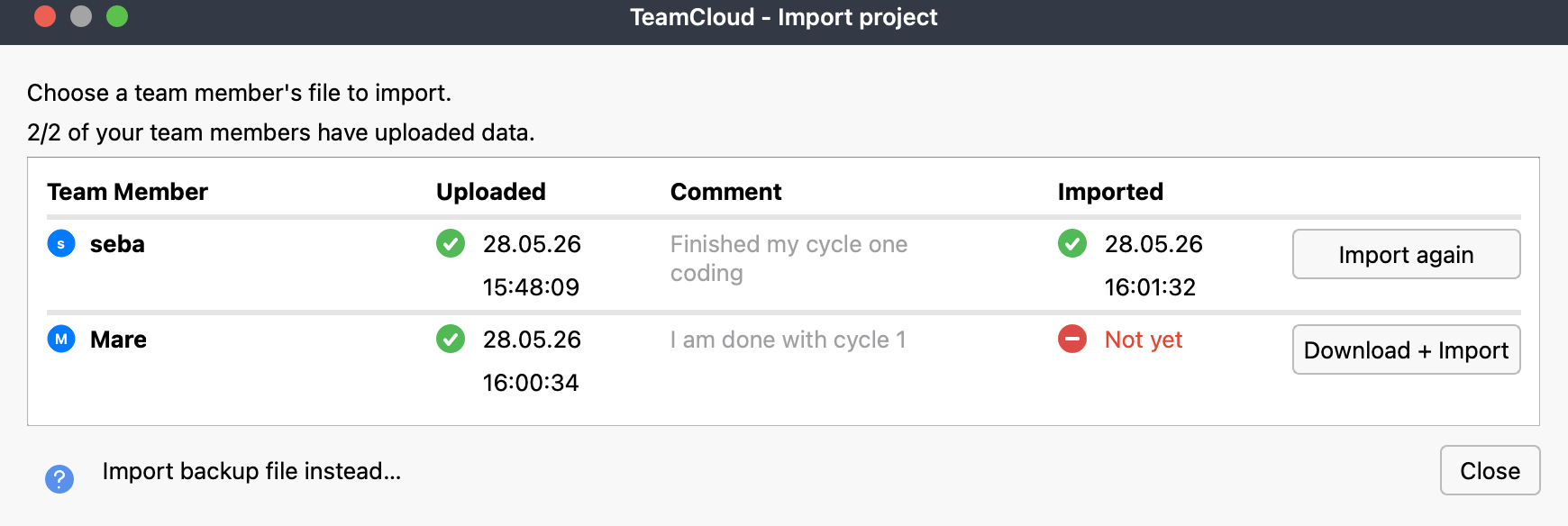
- Download and import each member's file. You can import the same file more than once using the Import again button if you want to bring in different elements separately.
- The import runs in two steps. First, you review document-related elements.
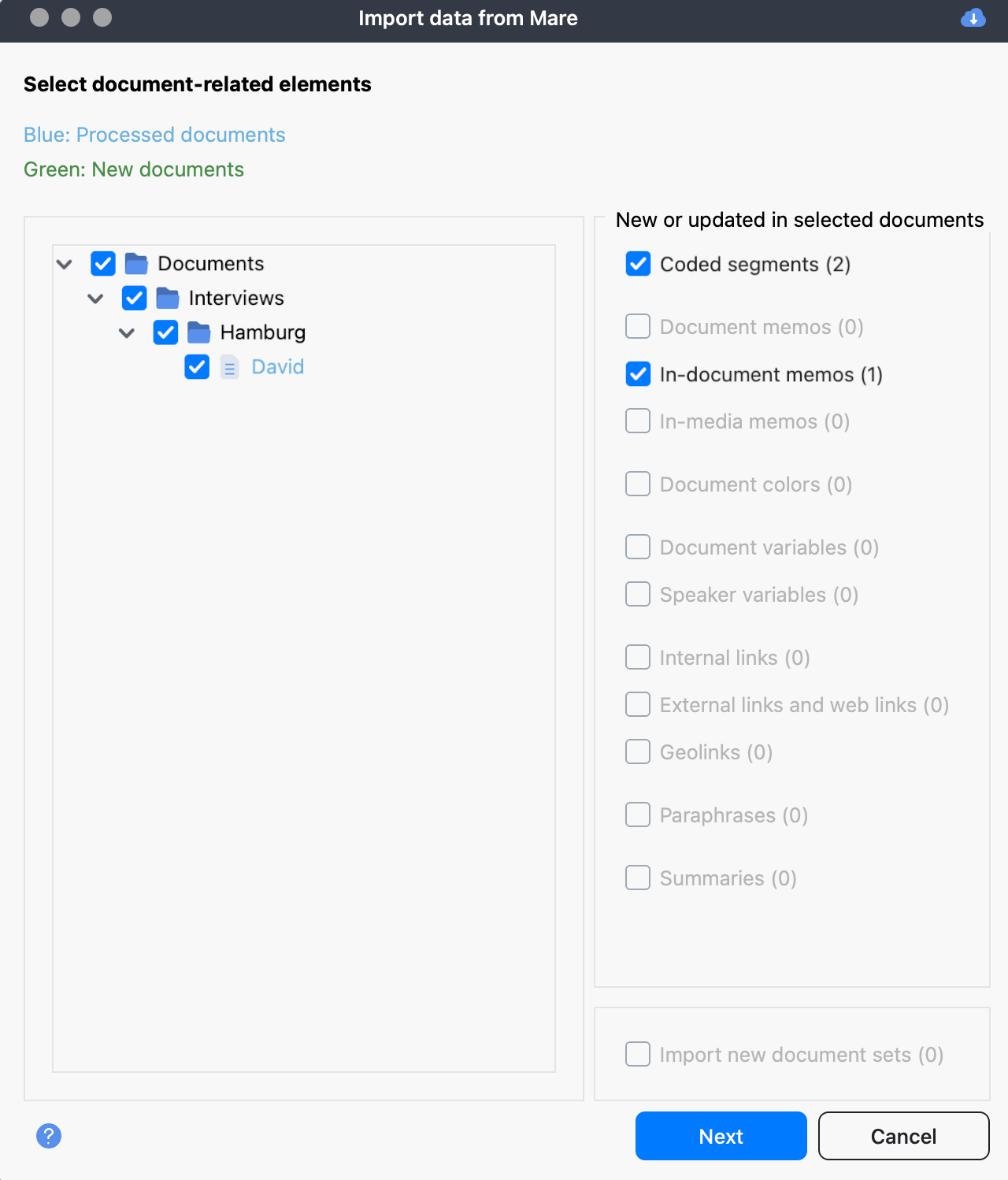
- The left column lists new documents (green) and existing documents with changes to import (blue).
- The right column shows which elements you can import from the selected documents. The number in parentheses gives the total across those documents. For example, "Coded segments (3)" means 3 coded segments were added or updated across all selected documents.
- Select or deselect elements as needed and click Next.
- The second dialog shows document-independent elements such as free memos, summary tables, and maps.
- Finalize your selection and start the import.
After a successful import, MAXQDA displays a log of everything imported into the main project.
MAXQDA also saves the import log as a free memo, which you can open at any time via Memos > Free Memos.
When a TeamCloud project is open, the functions Home > Teamwork > Teamwork Import/Export and Home > Merge Projects are unavailable to both team leads and team members. You can use these functions only in regular MAXQDA projects.
Email notifications
By default, you receive email notifications when members join, upload their work, or leave a project. To change which emails you receive, log in to your MAXQDA Account, click the MAXQDA TeamCloud tile on your MAXQDA Account dashboard, and open the Email Settings tab.
How import works: the four key rules
- Only work from the current cycle is imported. Anything created or edited before the current cycle started is ignored.
- In most cases, the most recently edited version wins. If two members edit the same element, MAXQDA imports the version with the later editing date. This also applies to the team lead. If you and a member edit the same element, MAXQDA imports the member's version when your edit is older.
- Deletions are never imported. If a team member deletes a code, memo, coded segment, or another element, MAXQDA does not apply that deletion to the main project. Elements can only be removed from the main project by the team lead.
- Moved or renamed documents and codes are treated as new. If a team member moves a code to a different parent or renames it, the result is imported as a new code, and the original remains unchanged in the main project. The same applies to documents. Recoloring a code is the only exception: color changes are ignored entirely.
For a detailed breakdown of how each element type is handled, including edge cases, see the Import reference tables at the bottom of this page.
Step 4: Edit the main project (team lead only)
After importing, you can make the changes that only the team lead can make:
- Edit documents
- Delete documents and codes
- Rename documents and codes
- Restructure the code system, for example, with AI Group Codes
Wait until you have imported all members' work for the cycle before making these changes. Otherwise, a later import can undo them. A deleted code comes back if you import a member's project that still contains it, and a renamed code reappears under its old name. Ask your team members not to work on the project until you start the next cycle.
Step 5: Start a new cycle or finish the project
Starting a new cycle
Each time you upload the main project, you start a new cycle, even if you have not imported any work. Upload only when you are ready to begin the next cycle.
When you have imported everyone's work and made your edits, upload the updated main project to start the next cycle.
In the TeamCloud menu, click Upload Project for Team (Start Cycle N).
Before the upload for the new cycle starts, MAXQDA shows each member's upload status and whether you have imported their work. Any unimported work is flagged in red, labeled "Not yet".
You can click Import to bring in any outstanding changes, or dismiss the check and proceed with the upload.
As with the first upload, enter notes for your team in the upload dialog.
You cannot import work that team members have not uploaded. Their unuploaded changes are overwritten when they download the new cycle. MAXQDA warns you if members have not uploaded their work or if you have not imported all available uploads. Make sure all work is accounted for before proceeding.
Once the upload is complete, the new cycle begins. Team members are notified by email and in MAXQDA and can download the updated file to begin the next cycle.
Finishing the project
When your team's work is complete, export the main project as a regular MAXQDA project file to keep a final version.
In the TeamCloud menu, click Export as Local Project, then choose a save location. The exported file is a regular MAXQDA project (.mqda). You can open it in a compatible version of MAXQDA or share it with your team by email or through a shared drive.
Exporting does not delete the TeamCloud project. If you no longer need it in TeamCloud, you can delete it on the TeamCloud website.
What happens during upload
When you upload a regular MAXQDA project for the first time, MAXQDA does the following:
- Your regular MAXQDA project is converted to the TeamCloud format (.mqtc) and saved in your TeamCloud workspace.
- PDF, image, audio, and video files are saved as external files in the TeamCloud workspace.
- A copy of the project and all associated files is uploaded to TeamCloud.
- Your original project file remains unchanged in its original location.
- If user management was enabled for local teamwork, MAXQDA disables it automatically.
By default, your TeamCloud workspace is stored in:
- Windows: %APPDATA%\MAXQDA\TeamCloudWorkspace
- macOS: ~/Library/Application Support/MAXQDA/TeamCloudWorkspace
You can change this location under TeamCloud > Account > Settings. Do not rename, move, or delete anything in the TeamCloud workspace: it breaks your TeamCloud projects. See where TeamCloud stores your projects.
Import reference
The following tables explain when MAXQDA imports each type of element and how it handles conflicts. They are intended as reference material rather than instructions for everyday use.
Document-related elements
| Element | Imported when | Notes and conflict handling |
|---|---|---|
| Codes | No code with the same name exists at that position in the hierarchy | Code color and order are not carried over. Changes to code alias names are ignored. |
| Code sets | No code set with the same name exists | The import dialog has an option for importing new code sets. Changes to existing code sets (added or removed codes) are ignored. |
| Coded segments | Creation or editing date is more recent than the start of the current cycle, and no newer coding exists at that position | Editing includes changes to weight, comment, and segment boundaries. Deleting a comment counts as a change. The imported coding replaces all existing codings of the same code at that position, leaving at most one coding per code per segment. |
| Document memos | Creation or editing date is more recent than the start of the current cycle, and no newer memo exists on that document | Older existing memos are replaced. |
| In-document memos and in-media memos | Creation or editing date is more recent than the start of the current cycle, and no newer memo exists at that position | Moved in-document memos are imported as new memos if the new assignment area is entirely outside the old one. Moved in-media memos are always imported as new memos. Memos with changed titles are added as new memos. |
| Document colors | Colors differ | Special case: the most recently edited version does not win here. MAXQDA applies the version from the last imported project. |
| Document variables | Creation or editing date is more recent than the start of the current cycle and more recent than the existing variable's last edit date | New text and date variables containing only empty values are not imported. Variables deleted by the team lead are not reimported within the same cycle. |
| Focus group variables | Same as document variables | Same as document variables |
| Internal links (between documents) | Creation date is more recent than the start of the current cycle and more recent than any existing link at that position | Links that overlap with a new link are replaced. |
| External links, geolinks, and web links (in document) | Creation date is more recent than the start of the current cycle and more recent than any existing link at that position | Links that overlap with a new link are replaced. |
| External links (in document properties) | External links differ | Special case: the most recently edited version does not win here. The version from the last imported project is applied. |
| Paraphrases | Creation or editing date is more recent than the start of the current cycle, and no newer paraphrase exists at that position | All overlapping existing paraphrases are replaced. |
| Summaries | Creation or editing date is more recent than the start of the current cycle, and no newer summary exists at that position | Older existing summaries are replaced. |
| Document sets | Name does not yet exist | The first import dialog has an Import new document sets option. MAXQDA does not import changes to existing sets. New sets are added without conflict. |
Document-independent elements
| Element | Imported when | Notes and conflict handling |
|---|---|---|
| Project memo | Creation or editing date is more recent than the start of the current cycle, and no newer project memo exists | Older existing project memo is replaced. |
| Document group and document set memos | Same as project memo | Same as project memo |
| Free memos | Creation or editing date is more recent than the start of the current cycle | Existing memos with the same title and creation date are replaced. If the title does not exist yet, or the creation dates differ, the memo is added as a new free memo. |
| Code memos | Same as project memo | Same as project memo |
| Code set memos | Same as project memo | Same as project memo |
| Code variables | Same as document variables (see table above) | Same as document variables (see table above) |
| Summary tables | Creation or editing date is more recent than the start of the current cycle | Existing summary tables with the same name and creation date are replaced. |
| QTT worksheets | Creation or editing date is more recent than the start of the current cycle | Existing worksheets with the same name and creation date are replaced. If a new worksheet has a name that already exists, MAXQDA adds a sequential number suffix. |
| Maps (MAXMaps) | Creation or editing date is more recent than the start of the current cycle | Existing maps with the same name and creation date are replaced. |
| Internal links (start or end point in a memo) | Creation date is more recent than the start of the current cycle and more recent than any existing link at that position | Links overlapping with a new link are replaced. If the start or end point is in a document, the link is only imported if that document was selected in the first import dialog. |
What is never imported
The following elements are always excluded from import, regardless of when they were created or edited:
- Stop word lists, go word lists, and dictionaries from MAXDictio (these can be transferred separately via Excel export and import)
- Geolinks in MAXMaps
- Codes or coded segments added inside memos
- Changes to existing timestamps
- Changes to a document set (removal or addition of documents)
- Changes to an existing code set (removal or addition of codes)
- Distance matrices and similarity matrices from Mixed Methods > Similarity Analysis for Documents
- New documents added by members if a document with the same name and hierarchical position already exists in the team lead's project
- AI Chat histories from team members. The team lead's AI Chat history is part of the main project, so the team receives it with each new cycle.
