
 Ready for MAXQDA?
MAXQDA vs. NVivo vs. ATLAS.ti
You’re deciding which QDA software to use for your next research project – or you’re considering switching from NVivo or ATLAS.ti? You’ve come to the right place. This QDA software comparison shows what sets MAXQDA apart from the competition and makes it the best choice for your qualitative research – with concrete examples that make the difference in everyday research work.
QDA Software Comparison: What Really Matters?
Anyone analyzing qualitative data knows the requirements: reliable coding, flexible visualizations, a well-thought-out workflow and ideally software that keeps pace with your thinking rather than slowing it down. NVivo and ATLAS.ti are established names in the market. So is MAXQDA. But not all QDA tools are equal, and depending on your research design, the differences can be significant.
What many researchers only discover after switching: the decisive differences often don’t lie in the basic functions, but in the depth of mixed methods integration, the quality of visualizations, the transparency of AI features, the question of platform parity – and not least, who owns the software and where your data resides.
The Only True Mixed Methods Tool on the Market
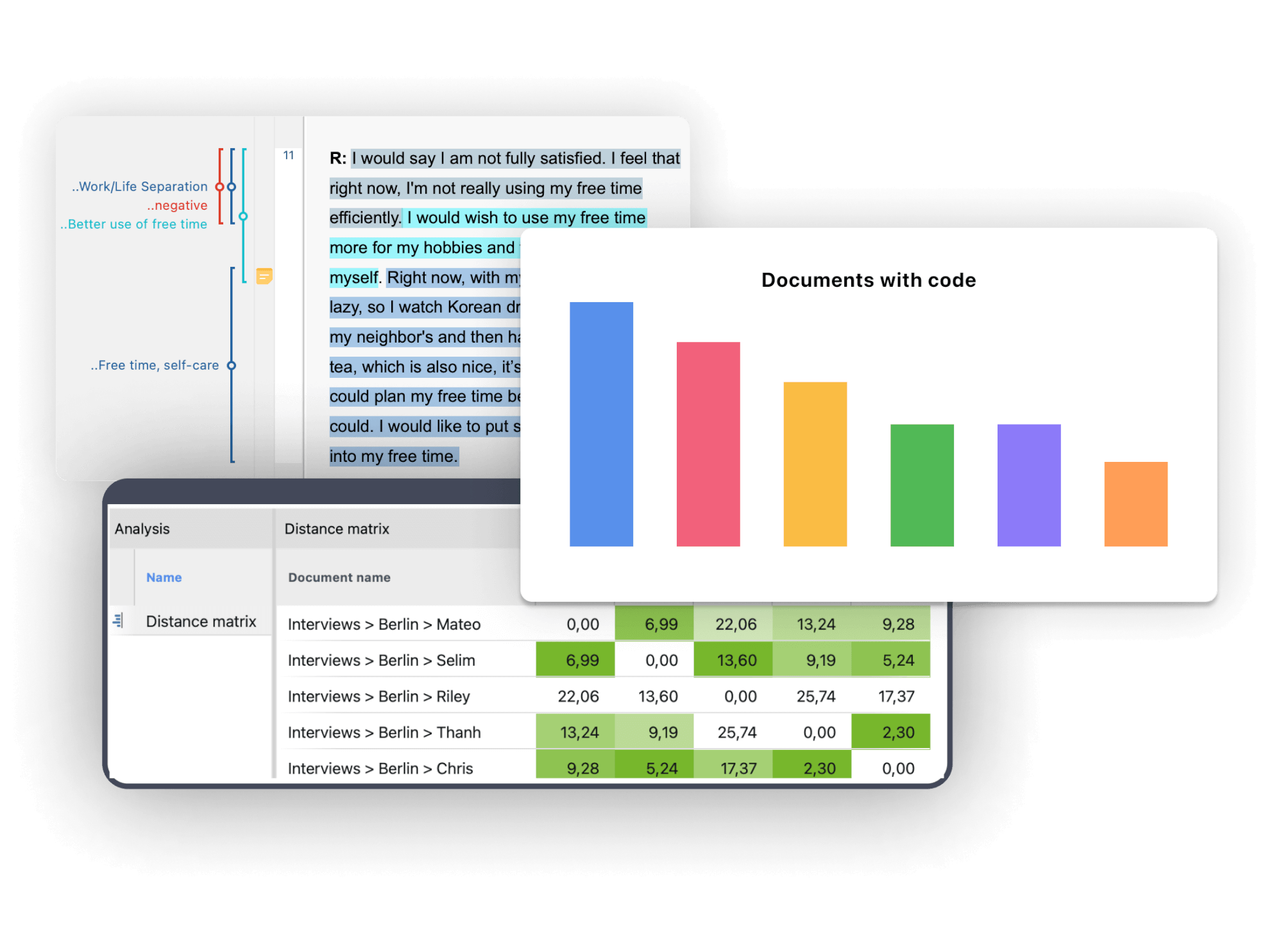
MAXQDA is the only QDA software with a fully integrated statistics module. Descriptive and inferential analyses can be carried out directly in the same environment where you code your interviews and write memos – no export to SPSS or R, no manual merging of results.
Both NVivo and ATLAS.ti lack this module entirely. Researchers pursuing mixed methods designs must resort to external statistics software with these tools and tediously synchronize data between applications. In MAXQDA, everything stays in one workspace.
Add to that features that are only partially available in NVivo and not at all in ATLAS.ti: code and document variables, a dedicated survey workspace, and with QTT (Questions-Themes-Theories) a dedicated workspace that builds a bridge between your project and a research report. This allows codes, memos, visualizations, and diagrams to be brought together in a single exportable document – directly from the analysis process, without detours.
A Multi-Level Code System
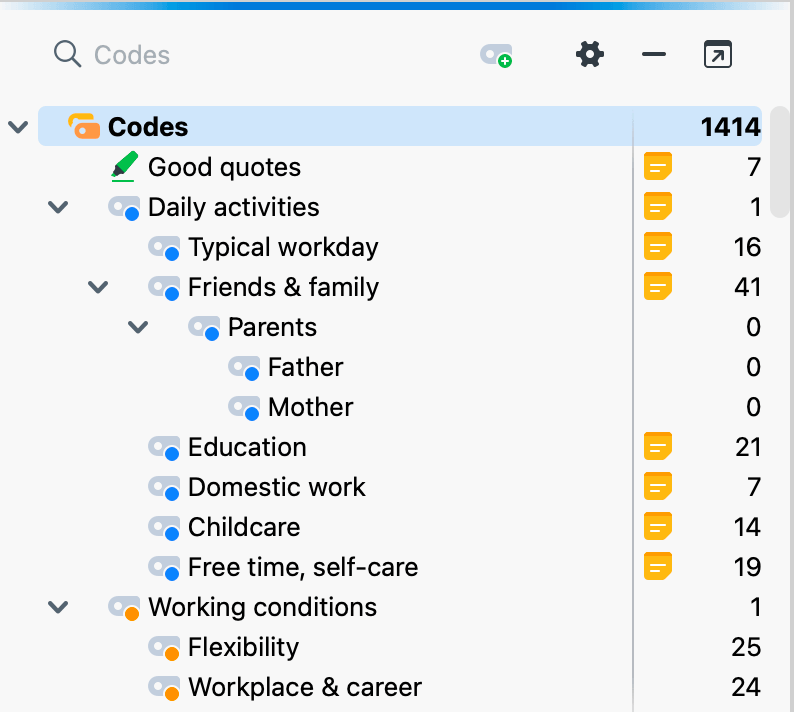
Here is a detail that quickly pushes ATLAS.ti users to their limits: ATLAS.ti limits code hierarchies to a maximum of two levels. Anyone developing more complex code systems – for instance in Grounded Theory studies or extensive content analyses – must work within this structural limitation.
In MAXQDA, code systems can be organized with as many subcodes as you need for your analysis. That may sound like a technical detail, but in practice it represents a significant difference in analytical freedom.
Visualizations No Other Tool Offers
Qualitative data analysis often requires the visual representation of research findings. MAXQDA offers visualizations that exist in this form in neither NVivo nor ATLAS.ti:
Document Portrait: This QDA software comparison shows at a glance how codes are distributed within a document – color-coded and immediately interpretable. Ideal for comparing interview progressions or analyzing pattern shifts within a text.
Code Trends & Word Trends: Track how frequently specific codes or terms appear across documents – over time or by other ordering criteria. Particularly useful for longitudinal studies or media analyses.
Color as an analytical dimension: In MAXQDA, color is not a decorative element. Codes and documents can be color-structured and used for advanced filtering and visualization. NVivo supports this only partially, ATLAS.ti likewise only to a limited extent.
These visualizations are not add-ons – they are an integral part of the analytical path from raw coding to theory building.
Writing Within the Research Process: Memos, Paraphrases, Summary Tables
One of MAXQDA’s strongest – and least discussed – features is the seamless integration of writing and analysis. Interpretation does not begin at the end but already during coding, and MAXQDA effortlessly supports this.
Memos in MAXQDA are more than just notes. They are linked workspaces directly connected to codes, segments, and documents, in which summaries can be created manually or with the help of AI Assist. The new memo layout makes it possible to read and edit summaries and memos side by side.
Paraphrasing tool: MAXQDA offers a dedicated workflow for writing paraphrases that remain linked to the original text and are available for further analysis. Neither NVivo nor ATLAS.ti offer this function.
Summary Tables: Analytical summaries can be systematically compared across documents and codes in MAXQDA – a central instrument for comparative case analysis. NVivo supports this only partially, ATLAS.ti not at all.
The result: analysis and interpretation happen not sequentially, but simultaneously. This saves time and improves the quality of the argument.
AI on Your Terms – Methodologically Grounded
On the topic of AI, the three providers of qualitative data analysis differ fundamentally. The difference is not only technical but also methodological in nature.
MAXQDA AI Assist is fully opt-in: no AI feature is activated automatically, no analysis runs in the background without your knowledge. This corresponds to the legitimate demand of qualitative research for transparency and traceability.
ATLAS.ti, by contrast, bundles AI features into its subscriptions by default – a model that researchers do not always choose consciously. Anyone who wants to maintain methodological control over their analysis process will find the more thoughtfully designed solution in MAXQDA.
What MAXQDA AI Assist concretely offers: AI Coding for documents and coded segments, AI-assisted summaries, paraphrasing, concept explanations, and translations, an AI Chat with your data, and AI Reports – automatically generated reports based on a research question, with direct links to the original sources. All AI outputs are clearly marked as such and are thus fully integrated and documented within the research process.

Two recent peer-reviewed studies underscore the methodological value: A study from George Mason University (Ayik et al., 2026) shows that MAXQDA AI Assist maps human codings more accurately than ATLAS.ti AI, ChatGPT, and other tested tools – and is the only system to recognize the interconnectedness of themes across multiple research questions. A study from the University of Essex (Wheeler, 2026) highlights that MAXQDA’s transparency features enable a level of traceability that NVivo does not currently offer.
Platform Parity: Windows and macOS Truly Identical
MAXQDA is the only leading QDA software that offers the same feature set, the same user interface, and the same manual on Windows and macOS. Project files are fully interchangeable and compatible.
NVivo had significant functional differences between platforms for years. ATLAS.ti also offers only partial parity – certain features and displays vary depending on the operating system. Anyone working in a mixed team or switching between devices knows the problem. With MAXQDA, it does not exist.
PDF Handling: Details That Change the Workflow
MAXQDA offers two PDF features that are missing from NVivo and ATLAS.ti:
The first is built-in OCR text recognition for image-based PDFs. Scanned documents are automatically converted into searchable text – no third-party software required.
Second, the ability to exclude PDF areas from analysis: headers and footers can be excluded, so they do not distort codings, word counts, and search results. Anyone who regularly works with academic articles or standardized reports knows how often this becomes a problem.
Flexible Pricing – Only with MAXQDA
As this QDA software comparison shows, ATLAS.ti does not offer a modularly structured licensing model. Those who do not need certain features still pay for the complete package. MAXQDA, on the other hand, allows products and add-ons to be assembled according to your actual needs – MAXQDA, MAXQDA Analytics Pro, AI Assist, and TeamCloud can be combined individually. This lowers the entry barrier and allows researchers to let the software grow with their requirements, paying only for the modules they actually need.
Independent, European, GDPR-Compliant
MAXQDA is developed and distributed by VERBI Software – an independent, owner-managed company in Berlin. This is a structural advantage: no acquisition by a US corporation, no unresolved questions about data sovereignty.
All cloud services of MAXQDA – AI Assist, automatic transcription, TeamCloud – run on servers in the EU and ensure full GDPR compliance. For researchers at European universities and institutions working with sensitive data, this is a relevant difference.
Free MAXQDA Reader: Share Projects at No Cost
MAXQDA offers a free Reader that allows you to share your projects with supervisors, stakeholders, or colleagues who do not have their own MAXQDA license. Recipients can view and search projects – at no additional cost, without registration. Neither NVivo nor ATLAS.ti offer a comparable model.
Built for International Research Teams
The MAXQDA interface is available in 12 languages, and MAXQDA offers true multilingual text search – more than any other QDA software on the market. Add to that more than 300 certified trainers worldwide, users in 192 countries, and 36 years of experience in developing software for qualitative research.
Switching from NVivo or ATLAS.ti: How It Works
The transition is easier than expected. MAXQDA supports the import of projects via the universal REFI-QDA format, which can transfer sources, segments, codes, annotations, memos, links, cases, variables, and other project elements. Since QDA programs structure some elements differently, a careful review of the imported project after transfer is recommended. But the foundation of your existing work is preserved, so you can continue your work directly.
Simply try the free trial version with full functionality.
QDA Software Comparison Conclusion
MAXQDA is not simply another QDA software. It is the only solution that enables genuine mixed methods research in an environment that is identical on macOS and Windows, integrates analytical writing into the coding process, offers visualizations that no competitor has, and implements AI in a methodologically responsible way – on a platform that is independent, European, and developed from the outset for the needs of serious research.
Ready to switch to MAXQDA?
Start your 14-day free trial today and receive a 20% discount code during your trial period.