
Citing MAXQDA correctly takes only a few minutes—once you know which citation approach applies. This guide shows you when a brief mention in your methods section is enough, and gives you ready-to-use full citations for the most common citation styles.

When Mentioning MAXQDA in the Methods Section Is Enough
MAXQDA is one of the most widely used software packages for qualitative and mixed methods research, and in many disciplinary communities it is considered standard software. In these communities, you typically do not need a full reference list entry. Mentioning the software in your methods section is enough.
Examples for a methods section:
We analyzed the interview transcripts using MAXQDA.
Descriptive statistics were calculated using MAXQDA Stats.
AI-assisted coding was carried out using MAXQDA AI Assist.
This approach is supported by APA 7 for common software (American Psychological Association, 2020, pp. 269, 338) and is consistent with the principle in MLA 9 and Chicago that software used purely as a tool does not require a reference list entry.
For a routine mention of MAXQDA in your methods section, the version number is usually not needed and is often omitted.
When You Need a Full Citation
Include a full reference list entry if any of the following applies:
- Your target outlet, such as a journal, publisher, university, or funding body, requires it.
- Your audience may not be familiar with MAXQDA.
- You quote or paraphrase MAXQDA documentation.
- You are citing MAXQDA Tailwind, our cloud-based tool. Because Tailwind is newer and less widely known, we recommend always including a full reference. See the MAXQDA Tailwind section below.
The rest of this guide gives you ready-to-use full citations for the most common citation styles.
How to Cite MAXQDA
This section shows the full citation format, including reference list entries. The examples assume you used MAXQDA 26 in 2026. Replace the version number and year with the version you actually used.
| Style Guide | In-text citation | Bibliographic Entry |
|---|---|---|
| APA 7 | We used MAXQDA 26 (VERBI Software, 2026) for data analysis. | VERBI Software. (2026). MAXQDA (Version 26) [Computer software]. https://www.maxqda.com |
| Chicago, notes-bibliography | We used MAXQDA 26 for data analysis.1 1 VERBI Software, MAXQDA, version 26, 2026, https://www.maxqda.com. | VERBI Software. MAXQDA. Version 26. 2026. https://www.maxqda.com. |
| Chicago, author-date | We used MAXQDA 26 (VERBI Software 2026) for data analysis. | VERBI Software. 2026. MAXQDA. Version 26. https://www.maxqda.com. |
| MLA 9 | We used MAXQDA, version 26, for data analysis. | MAXQDA. Version 26, VERBI Software, 2026, www.maxqda.com. |
| Harvard | We used MAXQDA 26 (VERBI Software 2026) for data analysis. | VERBI Software 2026, MAXQDA, version 26, computer software, accessed [day month year], https://www.maxqda.com. |
| Vancouver | We used MAXQDA 26 [1] for data analysis. | [1] VERBI Software. MAXQDA. Version 26 [Computer software]. Berlin: VERBI Software; 2026. Available from: https://www.maxqda.com |
A note on Turabian: Turabian is a simplified version of the Chicago Manual of Style designed for student writers and widely used at U.S. universities. The citation format is essentially the same as Chicago, so you can use the Chicago examples above.
A note on Harvard: Harvard is not a single fixed style. Variants differ between institutions and disciplines, so always check the guidelines you need to follow.
A note on the version and year: Use the MAXQDA version and release year that were current when you completed your analysis, even if your project spanned several versions or years. Because MAXQDA receives regular updates throughout the year, the completion date of your analysis is the most practical reference point.
Where to Find Your MAXQDA Version Number
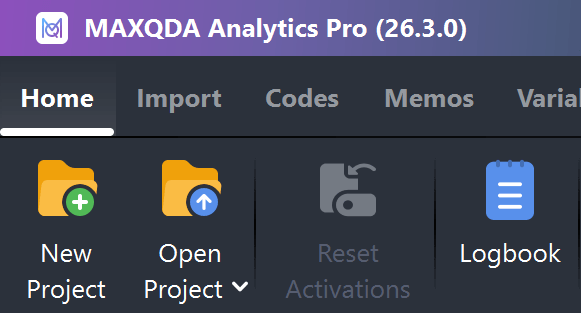
Your MAXQDA version number is shown in the title bar of the main application window, for example, “MAXQDA 26.” For most citation styles, the main version number is sufficient, so you can ignore any additional digits after the first dot.
Using Citation Managers
If you use a reference management tool such as Zotero, Citavi, EndNote, Mendeley, or JabRef, you can add MAXQDA as a manual entry. Most citation managers offer an entry type such as “Software,” “Computer Program,” or “Generic.”
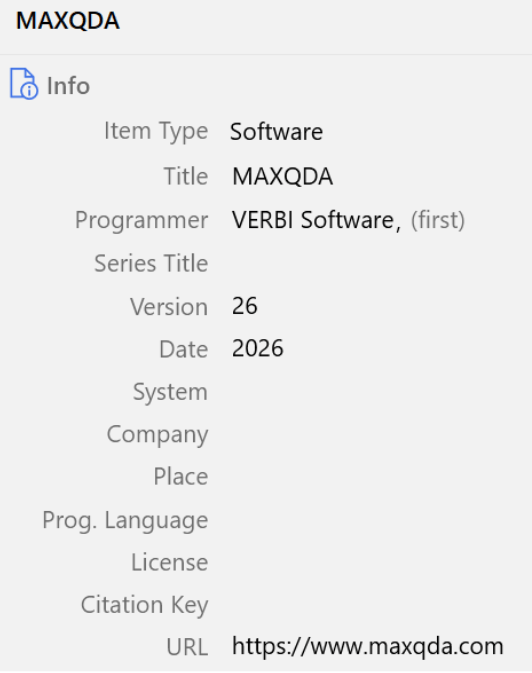
Fill in the fields as follows (this Zotero example can easily be adapted to other tools):
- Item Type: Software
- Title: MAXQDA
- Programmer: VERBI Software (in Zotero, use this field for the corporate author; in other tools, use “Author” or “Corporate Author”)
- Version: 26
- Date: 2026 (year of use)
- URL: https://www.maxqda.com
Once saved, your citation manager will automatically format the reference in the citation style required by your journal, publisher, or institution.
How to Cite MAXQDA Stats
MAXQDA is available in two license versions: MAXQDA Standard and MAXQDA Analytics Pro. The Analytics Pro version includes MAXQDA Stats, the built-in module for descriptive, inferential, and multivariate statistics.
The license version itself, Standard or Analytics Pro, is not cited separately. The reference list entry is always for MAXQDA. However, if you used the statistical functions included in Analytics Pro, mention MAXQDA Stats explicitly in your methods section so readers understand which tool was used for the statistical analysis.
Descriptive statistics were calculated using MAXQDA Stats (Version 26).
The reference list entry is the same as for MAXQDA in the table above, since MAXQDA Stats is part of the Analytics Pro license and not a separate product.
How to Cite MAXQDA AI Assist
If your analysis used AI-powered features in MAXQDA, such as AI-assisted coding, AI Summaries, or AI Reports, use the same reference list entry as for MAXQDA itself. AI Assist features are part of MAXQDA and not a separate application. You can therefore follow the examples in the MAXQDA citation table above.
In your methods section, mention MAXQDA AI Assist explicitly so readers understand which parts of the analysis involved AI.
Document summaries were created using MAXQDA AI Assist (Version 26).
How to Cite MAXQDA Tailwind
MAXQDA Tailwind, our web-based qualitative analysis platform with AI-supported features, is cited as a separate product. Use the year you worked with Tailwind as the reference year. MAXQDA Tailwind does not use publicly visible version numbers.
To help readers identify the tool, you may also include the web address in your methods section, although this is not required.
Sample methods section citation (APA 7):
We used the web application MAXQDA Tailwind (VERBI Software, 2026, https://www.maxqda-tailwind.com) for data analysis.
Reference list entry (APA 7):
VERBI Software. (2026). MAXQDA Tailwind [Computer software]. https://www.maxqda-tailwind.com
The same principle applies in other citation styles: use the product name MAXQDA Tailwind, include the year you used it, and provide the URL https://www.maxqda-tailwind.com.
How to Cite the MAXQDA Online Manual
If you refer to information from the MAXQDA Online Manual, for example when describing a specific feature or workflow, and cannot cite a relevant textbook such as Kuckartz and Rädiker (2019), cite it as you would any other online resource.
The MAXQDA Online Manual does not list publication dates for individual pages. Instead, it is updated continuously to reflect the latest MAXQDA release. For citation purposes, use the year you accessed the page. The access date helps identify the exact version of the page you consulted.
- Author: VERBI Software
- Date: the year you accessed the page
- Title: MAXQDA Online Manual when citing the overall manual, or MAXQDA Online Manual: [Chapter or Page Title] when citing a specific page
- URL: the address of the specific page you accessed
Sample in-text citation (APA 7):
MAXQDA’s Code Matrix Browser uses seven square sizes to visualize the frequency of code assignments (VERBI Software, 2026).
Reference list entry (APA 7):
VERBI Software. (2026). MAXQDA Online Manual: Code Matrix Browser (Codes by cases). Retrieved May 20, 2026, from https://www.maxqda.com/help/visual-tools/code-matrix-browser-visualizing-codes-per-document
The same principle applies in other citation styles: include the author, the access year, the manual title (with the chapter or page title where applicable), and the URL of the specific page you accessed.
Share Your Research
Have you used MAXQDA in your research and published the results in a paper, thesis, book chapter, report, or conference presentation? We’d love to hear about it.
The best place to share your work and connect with other MAXQDA users is the MAXQDA Research Community on LinkedIn, a growing network of researchers across disciplines and methodologies.