
Chapter 1: What Is Focus Group Research and When Should You Use It?
1.1 Definition and Core Concept of Focus Group Research
A focus group is a carefully planned research discussion designed to obtain perceptions on a defined area of interest, particularly in the context of marketing, media research, political campaigns, or user experience. The method brings together a small group of people, typically six to ten participants, who represent a certain target group. Participants are purposefully recruited because they share experiences, characteristics, or perspectives relevant to the study's objectives (Morgan, 1998b). A trained moderator guides the discussion using a semi-structured set of questions, encouraging participants to interact with one another, build on each other's responses, and explore topics in depth.

Krueger and Casey (2015, p. 2) define a focus group as a "special type of group in terms of purpose, size, composition, and procedures". The emphasis on "focus" is deliberate: focus groups are organized around a specific topic, follow a predetermined question sequence, and are conducted within a structured yet flexible framework.
What distinguishes focus group research from other forms of group discussion is its research intent. Rather than simply gathering opinions, focus groups can also shed light on social behaviour by allowing researchers to observe how people reason and negotiate meaning together. The term "focus group interview", widely used in the methodological literature, highlights that the method combines the depth of qualitative interviewing with the social dynamics of group interaction.
1.2 Key Characteristics of Focus Group Research
Several features set focus group research apart from other data-collection methods. First, focus groups rely on group interaction as the primary source of data. Participants do not simply answer questions in turn; they respond to one another, challenge assumptions, refine ideas, and co-construct meanings. Kitzinger (1995) argued that this interaction is the hallmark of focus group research methodology, because it reveals how people collectively negotiate understanding around a topic.
Second, focus group research is qualitative in nature. Focus groups produce rich, descriptive data including words, stories, and reactions rather than numerical scores. This makes the method particularly suited to exploratory research, where the goal is to understand how people think and feel about a topic or product rather than to measure the frequency of a given opinion.
Third, focus group research is focused: the moderator introduces specific topics and uses probing techniques to explore them systematically. This distinguishes focus groups from open-ended group discussions, where the conversation may drift freely. The structured question guide ensures that the research objectives remain central throughout the session.
Finally, focus groups are typically conducted in a series rather than as a one-off event. Krueger and Casey (2015) recommend running at least three to four groups, continuing until theoretical saturation is reached, that is, the point at which additional sessions yield no substantially new insights. It is also common to vary group composition across the series, moving from more heterogeneous to more homogeneous groups (Morgan, 1998b).
1.3 Best-Fit Goals for Focus Group Research
Focus groups are particularly well suited for research goals that benefit from social interaction and exploratory depth. These include exploring attitudes, beliefs, and perceptions about a product, service, brand, or social phenomenon; understanding the language and vocabulary that a target audience uses to talk about a topic; generating ideas for new products, campaigns, or program designs; testing reactions to concepts, advertisements, packaging, or messaging before large-scale quantitative testing; and understanding the reasons behind survey results or behavioural patterns that quantitative data alone cannot explain.
In marketing research, focus groups have a long and productive history. They are frequently used in brand strategy to uncover how consumers perceive a brand's personality, values, and positioning relative to competitors. They are used in product development to explore unmet needs, evaluate prototypes, and generate feature ideas. And they are used in communications research to pre-test advertising concepts, identify the most resonant messages, and refine creative executions before committing to expensive media placements (Stewart & Shamdasani, 2014).
1.4 Focus Group Research Compared to Other Methods
Understanding when to use focus group research requires understanding how it differs from alternative methods. Compared to individual interviews, focus groups offer less individual depth but provide a broader range of perspectives and the added value of group interaction. Individual interviews are preferable when topics are highly sensitive, when participants are difficult to assemble in one place, or when the research requires deep biographical narratives. Focus group research is preferable when the researcher wants to observe how people negotiate meaning together, or when group synergy is likely to produce richer data (Morgan, 1998a).
Compared to surveys, focus groups offer depth where surveys offer a larger scope. Surveys can measure the prevalence of attitudes across a large, representative sample, but they cannot reveal why people hold those attitudes or how they arrived at them. Focus group research can explore the reasoning, emotions, and social influences behind attitudes, but it cannot generalize findings to a population. The two methods are often complementary: focus groups can inform survey design by identifying relevant constructs and appropriate language, and surveys can follow up on focus group findings by testing their prevalence at scale.
Compared to usability testing, focus groups serve a different function. Usability testing observes individual users interacting with a product to identify interface problems; it is task based and behavioural. Focus groups, by contrast, explore perceptions, preferences, and reactions in a group setting and reveal how participants' attitudes and opinions influence one another.
Compared to Delphi methods, focus groups research is less structured and more interactive. Delphi methods are designed to build expert consensus through multiple rounds of (anonymous) questioning, which serves a fundamentally different purpose from the exploratory aims of most focus group research (Morgan, 1998a).
1.5 Common Misuses, Limitations and Challenges
Focus group research is not appropriate for every research question. Focus groups should not be used to reach consensus or make group decisions, as they are data collection tools rather than decision making forums. They should not be used to generalize to a population, since the small, purposive samples make statistical generalization impossible. They should not be used as a substitute for individual interviews when topics are deeply personal, stigmatized, or emotionally sensitive. And they should not be used when group dynamics are likely to produce conformity rather than open communication, for example when participants have authority relationships over one another (Krueger & Casey, 2015).
The principal limitations and challenges of focus groups include the potential for groupthink and social desirability bias, the difficulty of analysing interaction data as opposed to individual responses, the influence of the moderator on the direction and tone of discussion, and the challenge of recruiting and assembling participants. These limitations do not disqualify the method; they simply require careful design, skilled moderation, and transparent reporting, all of which are addressed in the chapters that follow.
Chapter 2: Types and Formats of Focus Groups for Focus Group Research
2.1 In-Person Focus Groups
The traditional in person focus group remains the standard against which other formats are measured. Participants gather in a dedicated room, often equipped with audio and video recording equipment, and comfortable seating arranged in a circle or around a table. The moderator facilitates face to face interaction, observing not only what participants say but how they say it: body language, facial expressions, and the overall energy of the room all contribute to the richness of the data.
In person groups typically include six to ten participants and last between 60 and 120 minutes (Morgan, 1998b). Krueger and Casey (2015) suggest that the ideal size depends on the complexity of the topic and the level of participant involvement: simpler topics or highly engaged participants may work well with eight to ten people, while complex or sensitive topics benefit from smaller groups of five to seven.
The physical presence of participants supports a more natural social setting, which aids spontaneity and tends to encourage more open debate. Rapport between the moderator and participants also builds more readily in person, enabling deeper probing and more candid responses. A useful framework for understanding how in person group dynamics unfold is Tuckman's model of group development (1965), which identifies five stages: forming, storming, norming, performing, and adjourning. The moderator's goal is to guide the group to the performing stage, where participants work with greater synergy and yield deeper insights. Reaching this stage is generally more straightforward in a face-to-face setting, where shared physical space and the absence of technological barriers help the group move through earlier, more tentative phases more quickly.
A further advantage of in person groups is the opportunity to use physical stimulus materials. Participants can handle prototypes, respond to printed materials, or take part in drawing exercises and role-playing activities that would be difficult to replicate in a remote environment. The moderator can also read the room more fully, noticing who is trying to speak, who appears uncertain, and who may be disengaging, and can adjust the discussion accordingly.
Practical Tips: When planning in-person groups, always over-recruit by 20 percent to compensate for no-shows. If you need eight participants, invite ten. Confirm attendance 48 hours before the session. Clear and timely logistical information, such as location, timing, and what to expect, also helps participants feel prepared and committed (Morgan, 1998b).
2.2 Online Focus Groups
Online focus groups have grown rapidly in adoption, accelerated by the shift to remote work during the COVID-19 pandemic and by the maturation of videoconferencing and qualitative research platforms. They can be synchronous, conducted in real time via video or chat, or asynchronous, conducted over several days on a discussion board where participants respond at their convenience. Each format carries distinct advantages and trade-offs that researchers should weigh carefully against their objectives.
Synchronous online groups (Lobe, 2017) closely resemble in person sessions: participants see and hear one another, the moderator guides the discussion in real time, and the session typically lasts 60 to 90 minutes. The main advantages are geographic reach, cost savings through the elimination of travel and facility rental, and greater convenience for participants. Modern online platforms also offer technological efficiencies such as breakout rooms, chat functions, polling tools, and screen sharing, as well as built-in recording and transcription that streamlines data capture. A further benefit is that the physical distance between participants can reduce the risk of groupthink, making it somewhat less likely that dominant voices will shape the responses of others.
However, online settings also introduce specific challenges. The moderator's ability to read nonverbal cues is reduced, and participants joining from home or the office may face distractions that affect their engagement. Researchers have also noted the phenomenon of online group fatigue, whereby the cognitive demands of participating in a video-based discussion, combined with limited interaction with other participants, can result in lower energy levels and a higher risk of dropout compared to in person settings.
Asynchronous online groups (Buddle et al., 2024) operate differently. Participants log in to a platform over a period of two to five days and respond to questions or prompts posted by the moderator and can also reply to one another's contributions. The written format and time available for reflection tend to produce more considered responses, and research suggests that online settings can encourage a degree of openness not always present in face to face groups, a phenomenon known as the online disinhibition effect (Suler, 2004), whereby people are more willing to discuss personal or sensitive topics in a mediated environment. However, the spontaneous real time interaction that characterizes in person groups is largely absent, and dropout rates can be higher if engagement is not carefully managed.

2.3 Special Formats of Focus Group Research
Hybrid focus groups combine in-person and remote participants in a single session, with some participants joining via video while others are physically present. This format offers flexibility but introduces complexity: the moderator must manage two different modes of participation, ensure that remote participants are equally included, and handle potential audio or visual delays. A hybrid setup should generally be the exception rather than the rule. It is usually better to choose either an in person or an online setting and design the session around that format consistently.
Mini focus groups (three to five participants) and dyads (two participants) are useful when topics are complex, sensitive, or require extended individual input. Smaller groups give each participant more speaking time and allow for deeper exploration of individual perspectives. They are also practical when the target population is small or hard to reach.
2.4 Choosing the Right Format
The choice of format for focus group research should be driven by the research objectives, the target audience, the budget, and practical constraints. In-person groups are strongest when nonverbal observation matters, when physical stimulus materials need to be handled, or when the topic benefits from the energy of face-to-face interaction. Online synchronous groups are best when geographic diversity is important, budgets are limited, or participants are difficult to assemble in one location. Asynchronous formats work well for reflective topics, longitudinal studies, or when participants span multiple time zones. Mini groups and dyads are appropriate when depth matters more than breadth or when the population is hard to reach. For projects where neither format alone is sufficient, a hybrid approach combining in person sessions for core audiences with online sessions for supporting groups can help achieve the benefits of both.
Chapter 3: Focus Group Research Design and Planning
3.1 Defining Objectives and Research Questions
Every focus group study begins with a clear statement of purpose. What decisions will this research inform? What do you need to know that you do not already know? Krueger and Casey (2015) recommend writing the research purpose in a single sentence and then deriving three to five specific research questions that the focus groups should address. These questions should be open ended, exploratory, and focused on understanding rather than on confirming hypotheses.
For marketing research, typical research questions might include:
- How do consumers in segment X perceive our brand relative to competitors?
- What unmet needs do frequent users experience with our product?
- How do potential customers react to our proposed messaging for a new campaign?
- What barriers prevent non-users from trying our service?
These questions guide every subsequent decision, from participant selection to question design to analysis strategy.
3.2 Sampling Strategy in Focus Group Research
Focus group sampling is purposive, not random. The goal is to select participants who can provide relevant information and rich perspectives on the research questions, rather than to achieve statistical representativeness. The sampling strategy typically involves defining segments (groups of people who share relevant characteristics), establishing screening criteria (the specific attributes that qualify or disqualify a person for inclusion), and setting quotas (the number of participants needed per segment).
Segmentation decisions should be driven by the research questions. If the study aims to compare brand perceptions across age groups, age becomes a segmentation variable. If the study explores user experience, segmentation might be based on frequency of use, tenure, or satisfaction level. Krueger and Casey (2015) emphasize the principle of homogeneity within groups and diversity across groups: each individual group should consist of participants who share the relevant segmentation characteristic, while the overall study should include groups representing different segments.
3.3 How Many Participants and How Many Groups?
The conventional recommendation is six to ten participants per focus group, with most researchers aiming for six to eight. Smaller groups (three to five) are appropriate for complex topics or expert populations; larger groups (up to twelve) may work for simple, high-energy topics or when participants have a low level of involvement with the topic. But larger groups are harder to moderate and give each participant less speaking time (Morgan, 1998b).
The number of groups depends on the number of segments and the principle of saturation. A common starting point is three to four groups per segment (Krueger & Casey, 2015). However, Hennink et al. (2019) found that as few as two groups per segment can provide a thorough understanding of the issues when the groups are well composed and the moderator is skilled. In practice, most research projects conduct between four and twelve groups in total. The key is to plan for enough groups to identify patterns reliably, while remaining open to adding sessions if saturation is not reached.
3.4 Timeline for Focus Group Research
A typical focus group study takes six to twelve weeks from planning through final reporting (Morgan, 1998b). The timeline includes research design (one to two weeks), recruiting (two to three weeks, often overlapping with design), fieldwork (one to two weeks), analysis (two to three weeks), and reporting (one to two weeks). Timelines compress or expand depending on the number of groups, the complexity of recruiting, and the scope of analysis required. Studies involving multiple segments, large volumes of transcript data, or detailed thematic analysis should plan for the longer end of this range.
Chapter 4: Recruiting Participants for Focus Group Research
4.1 Recruiting Sources
The quality of a focus group study depends heavily on the quality of its participants, which in turn depends on how well the recruiting process is designed. For student and academic research, the most accessible recruiting sources are personal and institutional networks, social media platforms, university mailing lists, and community groups. For marketing-oriented studies, specialized recruiting agencies maintain panels of pre-screened participants and can handle the logistics of finding and contacting suitable candidates, though this comes at a cost. Online panel providers are another option, offering broad demographic reach and relatively quick turnaround, though researchers should be aware that frequent panel participants can sometimes give polished, rehearsed answers that lack spontaneity.
Regardless of the source, Krueger and Casey (2015) recommend combining multiple recruiting channels where possible and always verifying eligibility through a screening instrument to ensure that the people who turn up are genuinely relevant to the research questions.
4.2 The Screener Survey
A screener is a short questionnaire used to determine whether a potential participant meets the study's eligibility criteria (Morgan, 1998b). It typically contains between five and fifteen questions and should be designed so that respondents cannot easily identify the answers that will get them selected. This means embedding the key qualifying questions within a broader set of questions and framing them around actual behaviour and experiences rather than attitudes or self-assessment. However, personal preferences and attitudes can certainly play a role in some situations, such as when evaluating music, sounds, or experiences. The most important thing is to think carefully about which selection criteria are truly essential for achieving the research objectives. Moreover, you can also use the questionnaire for describing the participants and use it as background information for your analysis (Barbour, 2014).
A screener should also include a few disqualification criteria, for example excluding people who work in a closely related field or who have taken part in a focus group very recently, as these participants may be overly familiar with the format.
A well-designed screener follows a simple flow: start with basic demographic questions to check eligibility, move to behavioural questions that confirm relevance to the topic, and close with practical questions about availability. Each question should have a clear pass or fail outcome so that whoever is handling the recruiting knows exactly who qualifies.
Practical Tip: Include a question that lists several product or service categories and see which ones the respondent selects. Someone who enthusiastically claims to use every option on the list may simply be trying to qualify, regardless of whether they are a relevant participant.
4.3 Incentives and Inclusive Recruiting
Incentives serve two purposes: they compensate participants for their time, and they reduce the likelihood of no-shows. The right incentive level depends on the audience, the length of the session, and how much effort participation requires, for example travel time, arranging childcare, or taking time off work. Incentives are often used synonymously to money. But in fact, we have different options here. Besides money, also product samples, early access to new features, or offering participant certificate can be helpful for recruitment. As a general principle, the incentive should be meaningful enough to motivate attendance without attracting people who are participating purely for the reward rather than out of genuine interest in the topic (Morgan, 1998b).
Inclusive recruiting means thinking carefully about who might be unintentionally excluded from participation. Practical considerations include physical accessibility of the venue, language needs, and digital literacy for online sessions. Beyond logistics, researchers working across cultural contexts should be aware that group discussion does not function the same way everywhere. In some cultural settings, open disagreement may be uncommon, participants may defer to those perceived as having higher status, or the format of a moderated group discussion may itself feel unfamiliar. Liamputtong (2011) emphasizes that focus group methodology must be thoughtfully adapted when working across cultures, with attention to communication styles, power dynamics, and the cultural appropriateness of the method itself.
Chapter 5: Writing the Discussion Guide
5.1 Question-Writing Principles
The discussion guide is the moderator's roadmap: a structured sequence of questions and activities designed to generate the data needed to address the research objectives. Good focus group questions share several properties (Krueger, 1998b). They are open ended, inviting narrative responses rather than yes or no answers. They are direct and forthright, but at the same time avoiding language that signals a preferred answer. They are simple and use everyday language rather than jargon or academic terms. And they move from general to specific, easing participants into the topic before exploring it in depth.
Krueger and Casey (2015) recommend keeping questions short, ideally a single sentence, and avoiding "why" questions, which can feel interrogative and push participants toward justifying themselves rather than reflecting genuinely. "What" and "how" questions tend to work better because they invite description and storytelling. For example, instead of asking "Why did you choose brand X?", try "Tell me about how you came to use brand X" or "What was going through your mind when you were deciding which brand to buy?"
Practical Tip: Test every question by reading it aloud. If it sounds like something a researcher would ask, rewrite it to sound like something a friend would ask over coffee. Focus group questions should invite conversation, not interrogation.
5.2 The Question Sequence
Krueger (1998b) describes a five-stage question sequence that has become the standard framework in applied focus group research.
Opening questions are easy and factual, designed to get every participant talking within the first few minutes. They establish the norm that everyone in the room contributes and should make feel people comfortable. Example: "Tell us your first name and one thing you did this past weekend."
Introductory questions introduce the general topic and invite participants to begin thinking about it in a broad, relaxed way. Example: "When you think about grocery shopping, what comes to mind first?"
Transition questions move the conversation from the general topic toward the specific issues the study aims to explore, serving as a bridge between the warmup and the core of the discussion. Example: "How has the way you shop for groceries changed in the last couple of years?"
Key questions are the heart of the discussion guide, typically three to five questions that directly address the research objectives. These receive the most time and the most follow up probing. Example: "I'd like to show you two versions of this product label. Take a moment to look at each one. What stands out to you? What do you think each one is trying to communicate?"
Ending questions bring the discussion to a close. They may include a summary question ("Is this a fair summary of what we've discussed?"), an open invitation ("Is there anything important we haven't covered?"), or a direct question tied to the research purpose ("What is the one thing you would change about this product?").
5.3 Example Questions by Research Goal
Different research goals call for different types of questions. A few practical examples across common areas:
Discovery and exploration: "What does a typical day look like for you when it comes to [topic]?" / "Walk me through the last time you [relevant experience]." / "What are the biggest frustrations you face when [activity]?"
Messaging and communications: "When you hear the phrase [tagline], what comes to mind?" / "If you had to explain this product to a friend, how would you describe it?" / "Which of these messages feels most relevant to your life?"
Pricing and value: "When you think about paying for [product/service], what feels like a fair price?" / "What would make you feel like you were getting good value?" / "What would make this feel too expensive?"
User experience: "Talk me through what you are thinking as you use this. What is confusing? What feels clear?" / "If you could change one thing about how this works, what would it be?"
Practical Tip: In practice, it can be very effective to present participants with a continuum between two opposing positions, for example "I really like it" versus "I don't like it at all", or "I feel drawn into the action" versus "I feel like an observer". Participants often find it easier to position themselves on a scale like this and then explain their reasoning, which can generate richer discussion than a direct question alone (Krueger, 1998b).
5.4 Activities and Stimulus Materials
Discussion guides often include activities that go beyond verbal questioning.
- Card sorts ask participants to organize concepts, features, or attributes into categories, revealing how they mentally structure a topic.
- Concept boards present visual representations of product ideas, brand positionings, or advertising executions for participants to react to.
- Projective techniques such as sentence completion or personification can surface attitudes that participants find difficult to express directly.
- Prototype interactions invite participants to handle or try out a physical or digital product and narrate their experience as they go. Krueger and Casey (2015) advise that materials should be developed enough to be meaningful but not so polished that participants feel they cannot criticize them.
5.5 Piloting and Revising the Guide
Before running the first group, the discussion guide should be pilot tested, ideally with a small group of people similar to the target participants, or at minimum through a walkthrough with colleagues. Piloting reveals questions that are confusing or redundant, activities that take longer than expected, and transitions that feel abrupt. It also helps the moderator become familiar with the guide's flow and rehearse probing strategies before the real sessions begin. The guide should be revised after the pilot and refined again between the first and second groups as early fieldwork reveals areas for improvement.
Chapter 6: Setup, Logistics, Ethics, and Data Capture
6.1 In-Person Setup
The physical environment has a real influence on the quality of the discussion (Morgan, 1998b). The ideal room is quiet, private, and free from distractions. Seating should be arranged in a circle or around a table so that all participants can see one another and the moderator. Name cards help everyone address each other by name, a small detail that noticeably improves the flow of conversation.
Recording equipment should be set up and tested before participants arrive. If observers are watching live, participants must be informed of this during the consent process. The check-in experience should be welcoming and efficient: greet participants at the door, verify their identity, collect signed consent forms, hand out name cards, offer refreshments, and get everyone seated before the moderator opens the session.
6.2 Online Setup
For online synchronous groups, platform selection matters (Lobe, 2017). The platform should support stable video and audio, screen sharing (for stimulus materials), a chat function (for activities or side questions), recording, and ideally breakout rooms. Regardless of platform, send participants a tech-check invitation one to two days before the session, including a link, login instructions, and troubleshooting tips.
At the start of the session, establish a few simple ground rules: whether participants should use the chat for comments, how they should signal that they want to speak, and how the moderator will manage turn taking. It is also worth preparing a backup plan for technical failures, such as a phone number participants can call, and a protocol for what happens if someone loses their connection mid-session. A co-moderator who handles the technical side while the moderator focuses on the discussion can be an asset in online settings.
6.3 Informed Consent and Recordings
Ethical practice requires obtaining informed consent from every participant before the session begins. The consent form should explain the purpose of the research, how data will be collected and used, who will have access to recordings and transcripts, the participant's right to withdraw at any time without penalty, and any risks associated with participation. For academic research, ethical review board approval is typically required before recruiting begins.
Most focus group studies rely on audio recording as the primary method of data capture, supported by notes taken by the moderator or a dedicated note taker. Video recording adds a useful layer of nonverbal information such as facial expressions, gestures, and body language, but also raises additional privacy considerations and may make some participants less comfortable (Barbour, 2014).
Chapter 7: Moderating the Focus Group
7.1 Core Moderator Skills
Effective moderation is both a science and an art. The moderator needs to listen actively, hearing not just words but meaning and emotion, probe skilfully without leading participants toward answers, and manage group dynamics.
Krueger and Casey (2015) describe the ideal moderator as someone who is genuinely curious about participants' perspectives, comfortable with silence, and able to create an atmosphere in which people feel respected and heard. A good moderator follows the discussion guide with discipline while remaining flexible enough to pursue unexpected but valuable threads when they arise. Furthermore, the moderator should stay in their role and not turn into a participant.
A co-moderator or assistant moderator can be a great asset, particularly for less experienced researchers, in larger groups or in online resp. hybrid settings (Krueger, 1998bc). While the moderator leads the conversation, the co-moderator takes notes, keeps track of the discussion guide, manages logistics such as timing and recording equipment, and can raise follow up questions if an important point is missed. In online sessions, the co-moderator also handles the technology, monitors the chat, and deals with any connectivity issues so that the moderator can stay focused on the group.
7.2 Opening Script and Ground Rules
The opening minutes of a focus group set the tone for everything that follows (Krueger and Casey, 2015). The moderator should introduce themselves, explain the general purpose of the discussion without revealing specific hypotheses, describe the format and how long the session will run, and establish a few simple ground rules.
Useful ground rules include: there are no right or wrong answers; all perspectives are welcome, including disagreements; one person speaks at a time; the session is being recorded for research purposes; and everything discussed stays confidential. Some moderators add a lighter note here, for example explaining that they may occasionally need to move the conversation on, not because anyone's contribution is unimportant, but simply to make sure everyone gets a chance to speak.
The opening question, typically a brief go-around-the-table introduction, serves a double purpose: it gets every participant speaking early and helps the moderator begin to learn names and read personalities before the discussion moves into its core topics.
7.3 Probing Techniques
Probing is the moderator's most important skill after listening. Good probes deepen understanding without steering the respondent toward a particular answer. Krueger and Casey (2015) describe several types that are worth knowing:
Elaboration probes invite the participant to expand on a response without suggesting a direction. Examples: "Tell me more about that." / "Can you give me an example?" / "What do you mean when you say [participants word]?"
Clarification probes help verify what a participant actually means. Examples: "I want to make sure I understand. Are you saying that...?" / "When you say 'quality,' what does that look like to you?"
Contrast probes use the group format to surface different perspectives. Examples: "[Name] mentioned X. Does anyone see it differently?" / "How does that compare to your own experience?"
Silence is perhaps the simplest and most underused probe of all. Waiting a few seconds after a participant finish speaking often prompts further reflection, either from that person or from others in the group who were considering whether to contribute.
7.4 Managing Group Dynamics
Every focus group contains a mix of personalities and managing that mix is central to the moderator's role (Krueger, 1998c). Participants who tend to dominate the conversation can be gently redirected: "Thank you, that's really helpful. I'd love to hear from some others on this." Quieter participants can be brought in with a direct but warm invitation: "[Name], I noticed you nodding. What's your take?" The goal is to create space for everyone without putting anyone on the spot.
Groupthink occurs when participants converge on a shared view not out of genuine agreement but out of politeness or the influence of a dominant voice. The moderator can counter this by explicitly inviting dissent ("Does anyone see this differently?"), by using brief written exercises before opening up the group discussion, or by reinforcing in the ground rules that a range of views is exactly what the research is looking for.
Disagreement between participants is usually a good sign rather than a problem. It surfaces genuine differences of opinion that are valuable data. The moderator should let it unfold while keeping it respectful: "It sounds like you two have had quite different experiences with this, which is exactly what we want to understand." If things become personal, a calm redirect works well: "Let's hear from a few others on this."
7.5 Closing the Session
A strong closing gives participants a sense of being heard and offers the moderator one final opportunity to capture important data. Krueger and Casey (2015) recommend a three-part close. First, the moderator briefly summarizes the key themes that came up and asks participants whether that summary feels accurate and complete. Second, the moderator asks an open invitation question such as "Is there anything important we haven't covered?" or "If you could tell the people behind this product one thing, what would it be?" Third, once participants have left, the moderator and co-moderator should take a few minutes to debrief while the session is still fresh: what stood out, what was surprising, what seemed consistent with other groups, and what early themes are beginning to emerge.
Chapter 8: Analysing Focus Group Research Data with MAXQDA
Analysis is the process of transforming focus group data from raw conversation into structured insights and recommendations. It is important to note that there is not one approach to analysing focus groups. Depending on the research goals and questions, the academic and/or marketing context, or the theoretical foundation, the focus may be more on the interaction or the content (Krueger, 1998a).
This chapter provides an overview of the most important analysis steps at a general level, explaining how MAXQDA supports each stage of the process, regardless of the analysis strategy employed. For a detailed discussion on focus group analysis strategies with MAXQDA see Loxton (2021).
8.1 The Hot Debrief: Fast Synthesis After Each Session
Analysis should begin immediately after each session, not once all groups have been completed. The hot debrief is a short, structured conversation between the moderator and co-moderator, and where appropriate any observers, conducted within 30 minutes of the session ending. The goal is to capture first impressions, notable quotes, emerging themes, surprises, and any adjustments that might improve subsequent sessions.
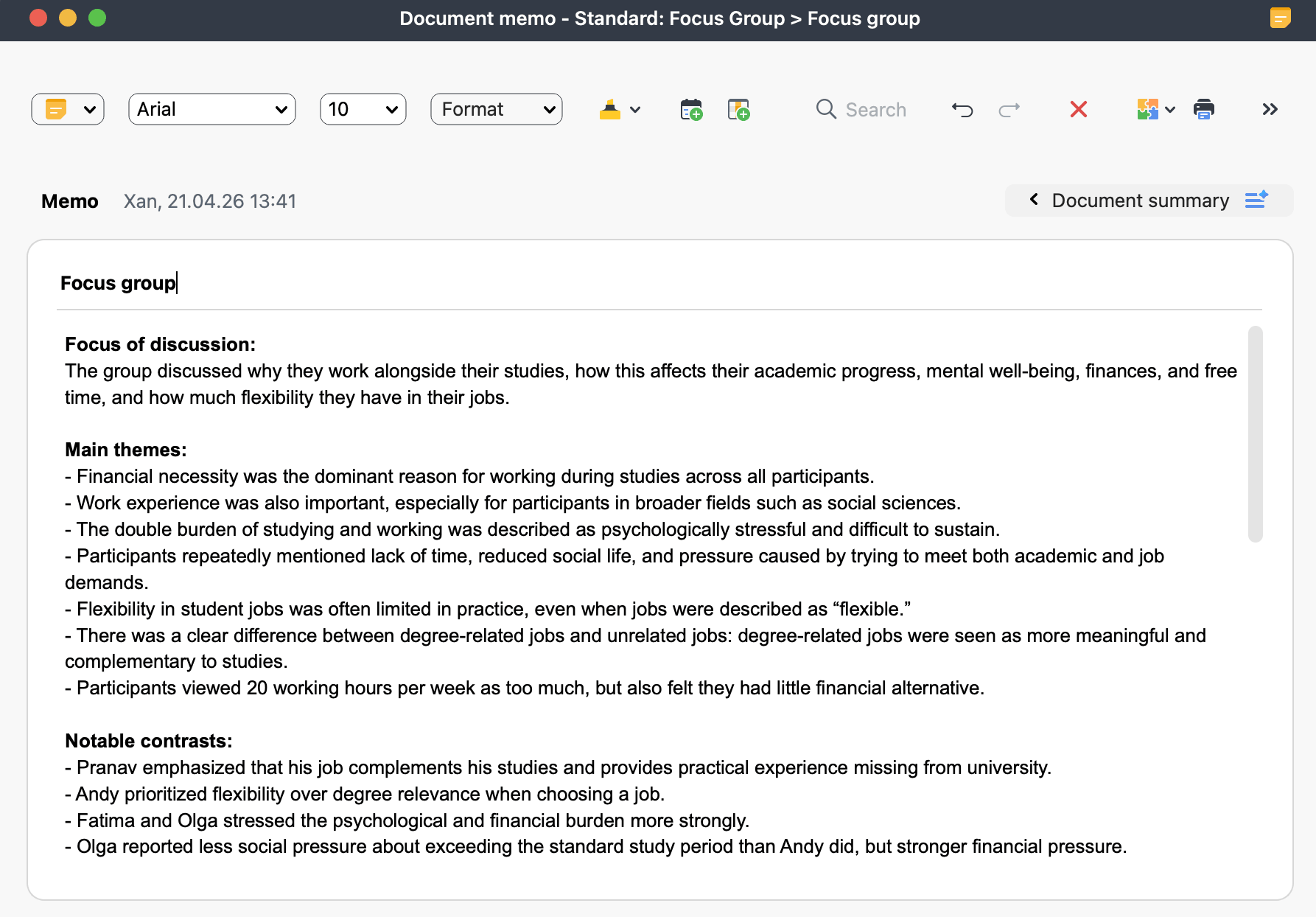
Krueger and Casey (2015) recommend structuring the debrief around the discussion guide: for each key question, the team briefly discusses what participants said, where they agreed or disagreed, and whether the data felt rich and complete.
Practical Tip: MAXQDA allows you to attach memos to documents, codes, or coded segments, which creates a useful layer of reflective notes alongside your raw data. Record your debrief notes as memos directly in your MAXQDA project file, for example as free memo in the main tab “Memos” or as document memo attached to the audio / video file (right click on the file > Memo).
8.2 Importing and Preparing Data for Analysis
Before analysis can begin, the data must be organised and prepared. The main data source in focus group research is typically a transcript, but audio and video recordings, moderator notes and any stimulus materials used during the session may also be included (Barbour, 2014). In MAXQDA, you can create a document group for each focus group and assign transcripts, recordings, notes, and other materials to it.
8.2.1 Transcription
Transcription is the standard preparation step before analysis. Transcripts should identify each speaker consistently using a pseudonym or participant number, and should note relevant nonverbal events such as laughter, pauses, or gestures toward stimulus materials. Accurate speaker labelling is particularly important in focus group research because it allows the researcher to track individual contributions, compare responses across participants, and identify patterns linked to participant characteristics.
Depending on the chosen analysis strategy, the transcription should either be more precise, or the speech flow should be smoothed. Conversation analysts should transcribe as precisely as possible and use the provided notation symbols for this purpose, for example the Jeffersonian transcription system (Rapley, 2007). The manual transcription function in MAXQDA can be used for this purpose. Conversely, if you are conducting a content analysis, you will probably aim for a smoother flow of speech in your transcription. The AI-based transcription function in MAXQDA is ideal for this.
8.2.2 Import
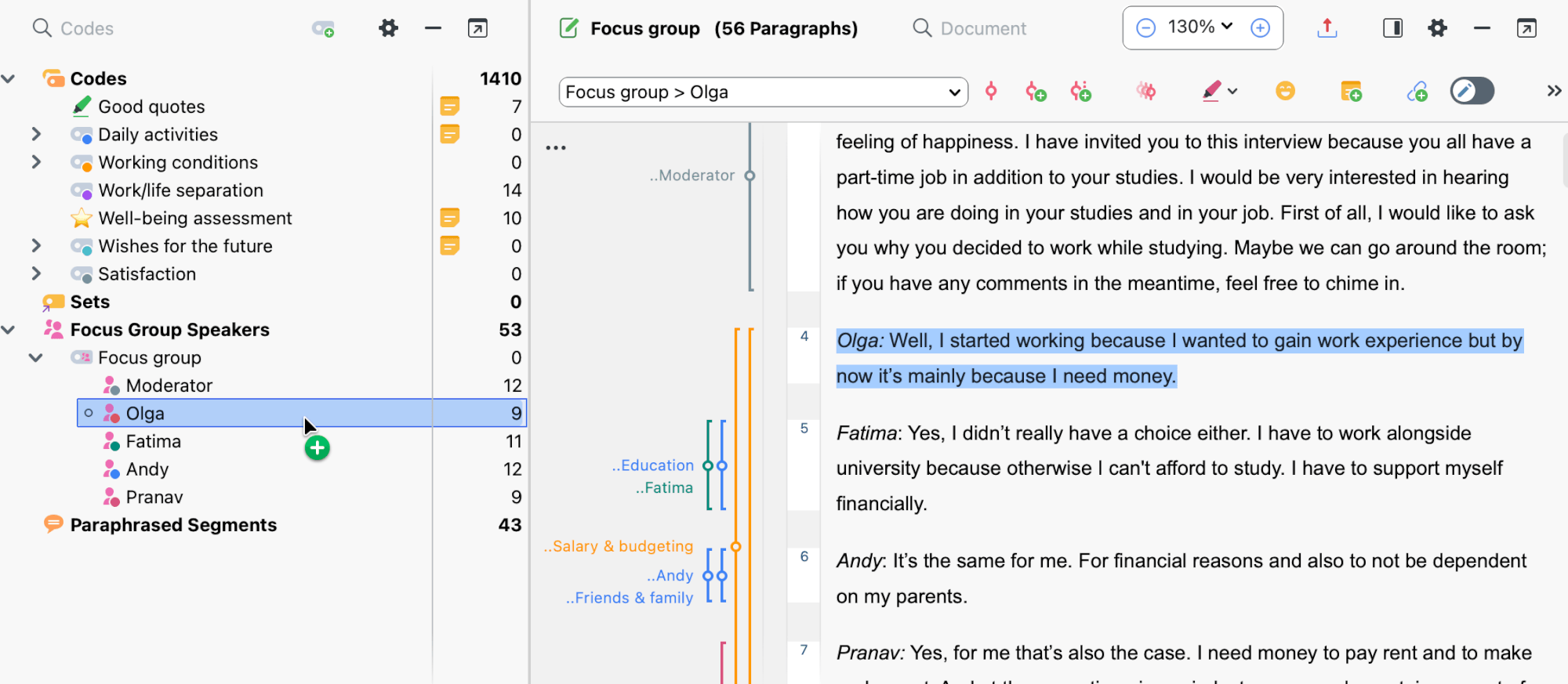
MAXQDA includes a dedicated Focus Group Transcript Import Function (Import > Focus Group Transcripts). When you import a transcript, MAXQDA automatically identifies each speaker and tags their contributions, creating a structured layer of speaker identification that powers all subsequent focus group features. For the import to work smoothly, transcripts should follow a simple convention: each new contribution begins in a new paragraph, with the speaker's name followed by a colon.
When you import a focus group transcript, MAXQDA automatically creates a new entry in the 'Document System' using the transcript's file name. Each participant is listed separately beneath the document, with the total number of their contributions shown at the end of their line. Speakers are tied directly to their parent document and will follow it whenever it is moved. Their display order can only be manually adjusted via drag-and-drop. A similar structure appears in the 'Code System': once the import is complete, a new code bearing the name of the focus group is added at the bottom. Each participant is represented as a subcode beneath this code.
Important: Although there is a function of separate speakers, it is important to bear in mind that interaction within the focus group is essential for the analysis. Participants influence one another and opinions evolve through interaction within the group. In most cases, it is best to avoid analyzing individual opinions in isolation from the group dynamics (Barbour, 2014).
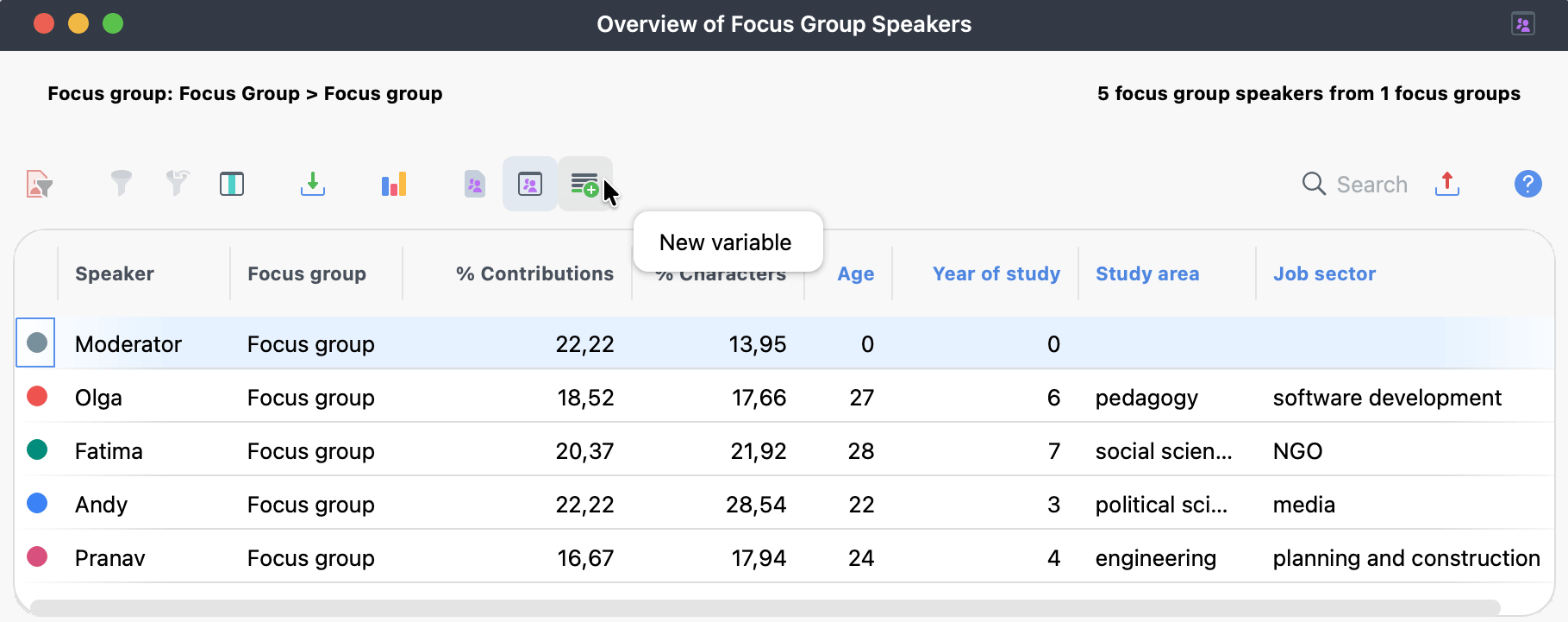
Once the data is imported, you can add more information per participant / speaker. The "Overview of Focus Group Speakers" These are stored in MAXQDA's Overview of Focus Group Speakers gives you the option to store additional information about each speaker through variables such as age, gender or profession. To open this overview, right click on a focus group in the "Document System" and select Overviews > Focus Group Speakers. It and can be used later to filter and compare findings by participant characteristics.
8.3 Coding: Developing, Applying, and Refining Your Code System
Loxton (2021) is covering plenty of different coding strategies in their MAXQDA Reader on focus group analysis. Therefore, this Research Guide just summarizes the most important aspects of coding on a general level. Coding is the core activity of qualitative analysis. It involves reading through the data, identifying meaningful passages, and assigning them descriptive or conceptual labels that capture their content or significance. In MAXQDA, codes are organized in a hierarchical Code System that can be expanded and refined as the analysis develops.
There are two main approaches of coding. Deductive coding starts with a pre-defined set of codes drawn from the research questions or discussion guide, which are then applied to relevant passages in the data. Inductive coding works the other way around: codes emerge from the data itself as patterns and recurring ideas become visible. Most focus group analysis combines both, beginning with a structure based on the key questions and adding new codes as the data reveals unexpected themes.
In MAXQDA, coding is straightforward: select a passage of text, drag it to a code in the Code System or create a new one on the spot, and the segment is coded. You can apply multiple codes to the same passage, organize codes into hierarchies such as "Brand perception > Positive associations" and use colour coding to distinguish different themes visually. MAXQDA also supports in-vivo coding, which creates a new code using the participant's exact words, a technique that is particularly useful for capturing the natural language of your target audience. As the analysis progresses, codes will inevitably evolve. Some will be merged, renamed, split, or removed. MAXQDA makes these adjustments easy, and the Code Frequency display helps identify codes that are overused, underused, or redundant.
A useful additional feature is MAXQDA's AI Assist, which can support the coding process by automatically suggesting subcodes, summarising coded segments, and helping to identify emerging patterns across large volumes of data. As with any AI-supported tool, the researcher should review and refine the suggestions rather than accepting them uncritically.
8.4 Analysing single focus groups
Each analysis begins with an independent examination of each focus group. For this step, it is best to use three tools in MAXQDA: the Codeline, the Code Matrix Browser and the Summary Grid.
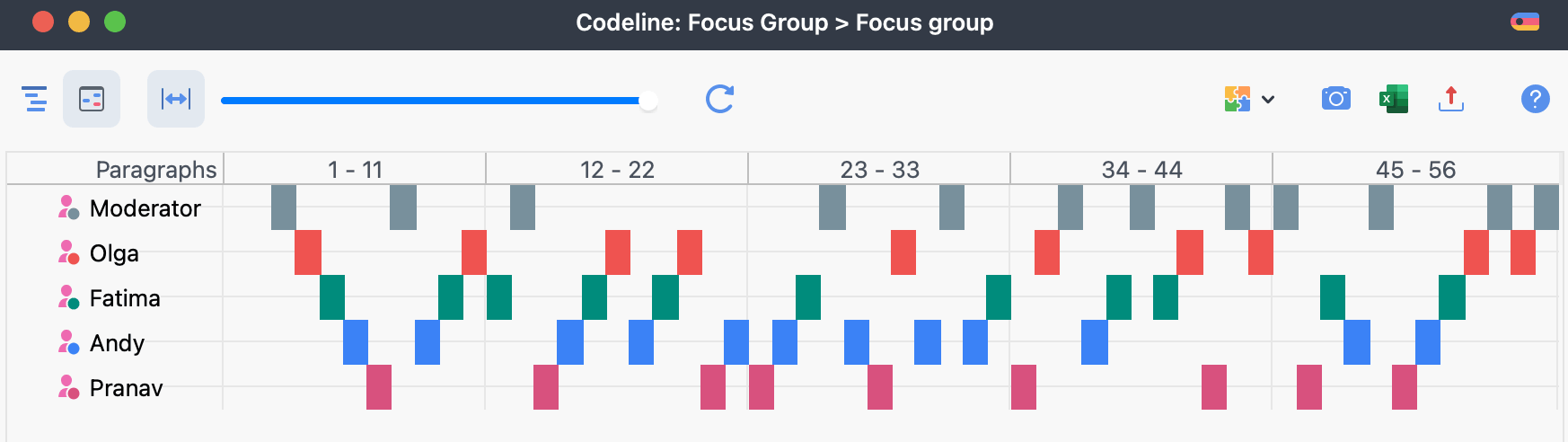
The Codeline is a visual, case-based tool that displays coded segments of a document in a sequential order similar to a musical score. It is particularly useful for analysing the flow of topics and participant engagement, as it makes it easy to identify the most active contributors, those who re-entered the conversation at multiple points, and those who appeared only once. Thus, the tool helps to ensure that interaction among participants is not overlooked. This feature can be accessed via Visual Tools > Codeline. The display is interactive: hovering over any symbol brings up a small information window showing the corresponding code or subcode name and its position.
When working with focus group data, the visual tool Code Matrix Browser can be configured to display participants rather than documents as column headers, giving you an immediate visual overview of which themes were raised by which speakers across all your sessions. The size of the squares in the matrix provides information about how many coded segments are associated with each code for each speaker, making it easy to spot at a glance, for example, that one participant contributed extensively to a given theme while another made no contribution to it at all. Cells in the matrix are interactive: double-clicking on any cell will immediately display the corresponding coded segments in the "Retrieved Segments" window, allowing you to move seamlessly between the overview and the underlying data.
Important: To make effective use of this feature for analysing individual focus groups, you must select the “focus group speakers” option in the Code Matrix Browser's start window.
The Summary Grid tool enables you to view all coded segments for each code and document, summarising them in relation to the research questions and objectives in a Summary window. It can be accessed via 'Analysis' > 'Summary Grid'. This tool can be used for detailed focus group analysis and can be adapted to different analysis strategies. Once all topics have been summarised and analysed, the summaries can be exported to summary tables (Analysis > Summary Table).
Important: If you want to use the Summary Grid for your analysis, it is important to code individual thematic threads at a high level during the coding process so that the course of the discussion can be mapped, analysed and summarised.
8.5 Comparing Across Groups
One of the key strengths of focus group research is the ability to compare findings across focus groups. MAXQDA offers several tools designed specifically for this.
The Code Matrix Browser is the natural starting point for cross-group comparison. It is the ideal tool for illustrating and analysing the distribution of coded segments across different documents, presenting documents in columns and codes in rows. This makes it easy to see immediately which themes are consistent across all groups and which appear only in specific sessions or segments. For cross-case analysis, you have to select “Documents” in the Browser’s start window. This visual format is particularly effective in early-stage analysis, when you are still mapping the overall thematic landscape across your groups. Similarly, you can also use the tools Summary Grid and Summary Table not only for a single focus group analysis for cross-case analysis.
The Crosstab for Focus Groups takes the comparison a step further by introducing participant variables into the analysis. MAXQDA offers the ability to store background information about each focus group speaker in the form of variables (see Overview of Focus Group Speakers), and the Crosstab for Focus Groups allows you to compare thematic coding across groups of speakers defined by those variables. The codes form the rows, and the speaker groups form the columns, with the respective code frequencies displayed in the cells. If, for instance, you have recorded participants' age group, professional background, or purchasing behavior as variables, you can use this tool to determine whether certain themes are more prominent among specific segments of your sample, and whether those patterns hold consistently across multiple sessions. Like the Code Matrix Browser, the Crosstab is fully interactive: double-clicking on any cell activates the relevant documents and codes and lists the corresponding segments for immediate review.
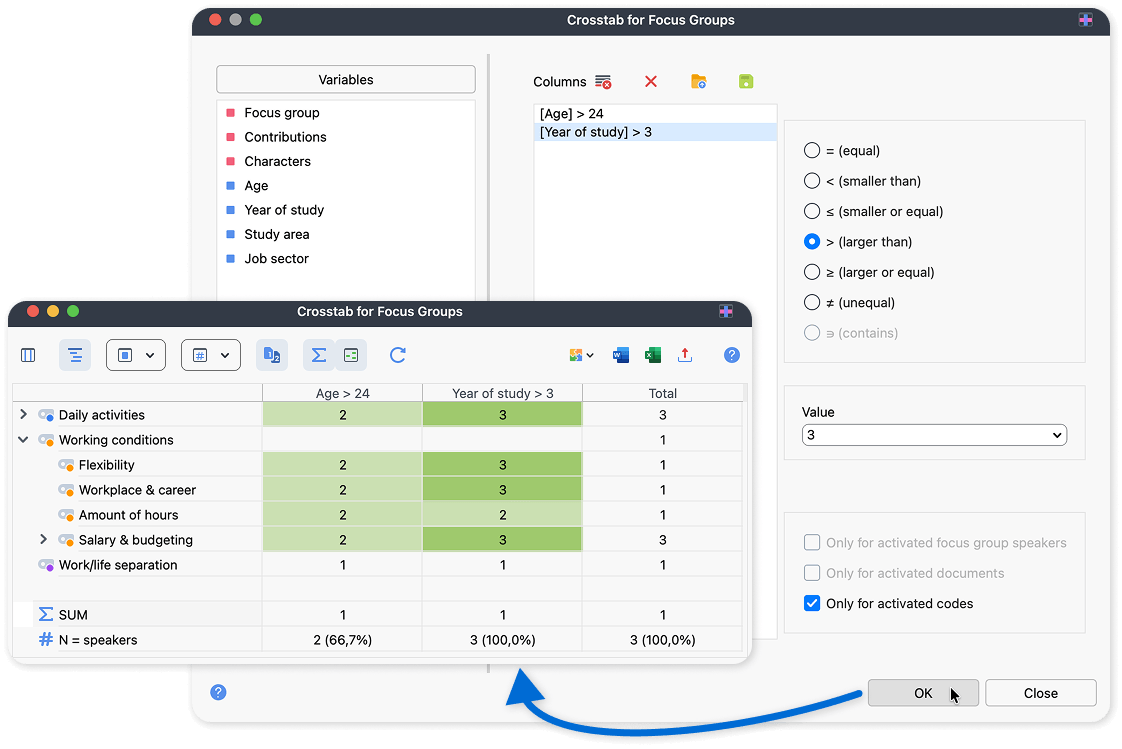
The Segment Matrix for Focus groups rounds out the toolkit by shifting the focus from frequency counts to actual content. It is based on the same logic as the Crosstab, creating a joint display of themes and participant characteristics, but operates at a more detailed and non-aggregated level: rather than showing the number of coded segments in each cell, it displays the segments themselves as text. This means you can read, side by side, exactly what participants from different groups or backgrounds said about each theme, complete with source references indicating the document, position, and code weight of each excerpt.
Chapter 9: Reporting and Communicating Focus Group Research Findings
9.1 From Themes to Insights and Recommendations
The analytical output of a focus group study is often a set of themes, recurring patterns in the data that address the research questions. But themes alone are not the final deliverable. The researcher's task is to transform themes into insights, interpretive statements that explain what the themes mean in context, and from there into recommendations, concrete suggestions for the decision-maker. Krueger (1998a) suggests thinking about the study of the purpose of the study and to consider the audience again before starting with the report.
A simple example illustrates the progression. A theme might be: "Participants consistently described brand X as reliable but boring." The corresponding insight could be: "Brand X has a strong foundation of trust, but its positioning lacks emotional resonance with younger consumers." The recommendation that follows might be: "Explore campaigns that build on the reliability association while adding warmth or aspiration to the brand personality." Moving from description to interpretation to recommendation requires analytical courage, but every step should remain grounded in what participants actually said. Direct quotes are the primary evidence: they show that findings come from the data, not from the researcher's assumptions.
Quotes should be selected to illustrate themes, not to prove them. A single vivid quote does not establish a pattern; it brings a pattern to life for the reader. Good quotes are representative, meaning they reflect a view expressed by multiple participants, specific enough to feel concrete, and clear enough to stand without extensive context. Sometimes it is also important to quote longer passages to show the progression of an argument (Barbour, 2014).
9.2 Exporting and Visualizing Results from MAXQDA
For presentations to non-research audiences such as marketing teams or product managers, MAXQDA's visualisations are particularly useful because they translate complex qualitative patterns into formats that are easy to understand at a glance, without requiring the audience to work through lengthy transcripts or thematic summaries.
MAXQDA offers a range of export options to make reporting easier. Coded segments can be exported to spreadsheets or word processing documents for inclusion in a written report. Visual tools such as the Code Matrix Browser can be exported as high resolution images for slides and publications. The Smart Publisher feature compiles coded segments, memos, and summaries into a structured report draft, which can reduce the time needed to produce a written deliverable.
References
Barbour, R. S. (2014). Analysing Focus Groups. In: U. Flick (Ed.), The SAGE Handbook of Qualitative Data Analysis, SAGE Publications, 313–326.
Buddle, E. A. et al. (2024). Emergent Design and Unanticipated Ideas in Asynchronous Online Focus Groups. Finding an Unexpected Silver Lining in Apparent Methodological Compromise. International Journal of Qualitative Methods, 23, https://doi.org/10.1177/16094069241289295.
Hennink, M. M., Kaiser, B. N., & Weber, M. B. (2019). What Influences Saturation? Estimating Sample Sizes in Focus Group Research. Qualitative Health Research, 29(10), 1483–1496.
Kitzinger, J. (1995). Qualitative Research. Introducing Focus Groups. BMJ, 311(7000), 299–302.
Krueger, R. A. (1998a). Analyzing and Reporting Focus Group Results. Focus Group Kit, Vol. 6. SAGE Publications.
Krueger, R. A. (1998b). Developing Questions for Focus Groups. Focus Group Kit, Vol. 3. SAGE Publications.
Krueger, R. A. (1998c). Moderating Focus Groups. Focus Group Kit, Vol. 4. SAGE Publications.
Krueger, R. A., & Casey, M. A. (2015). Focus Groups: A Practical Guide for Applied Research (5th ed.). SAGE Publications.
Liamputtong, P. (2011). Focus Group Methodology: Principles and Practice. SAGE Publications.
Lobe, B. (2017). Best Practices for Synchronous Online Focus Groups. In: R. S. Barbour & D. L. Morgan (Eds.), A New Era in Focus Groups Research. Challenges, Innovation and Practice, Palgrave Macmillan, 227–250.
Loxton, M. H. (2021). Analyzing Focus Groups with MAXQDA. Berlin: MAXQDA Press.
Morgan, D. L. (1998a). The Focus Group Guidebook. Focus Group Kit. Vol. 1. SAGE Publications.
Morgan, D. L. (1998b). Planning Focus Groups. Focus Group Kit. Vol. 2. SAGE Publications.
Rapley, T. (2007). Doing Conversation, Discourse and Document Analysis. SAGE Publications.
Stewart, D. W., & Shamdasani, P. N. (2014). Focus Groups: Theory and Practice (3rd ed.). SAGE Publications.
Suler, J. (2004). The Online Disinhibition Effect. CyberPsychology & Behavior, 7(3), 321–326.
Tuckman, B. W. (1965). Developmental Sequence in Small Groups. Psychological Bulletin, 63(6), 384–399.
About the author

Dr Susanne Sackl-Sharif is a sociologist and musicologist based in Austria. She has worked with MAXQDA software since 2009, using it to carry out many qualitative and mixed-methods projects. Since 2014, she has also been involved in academic coaching, supporting students and researchers with their MAXQDA projects. For further information see www.sackl-sharif.net.
