
Last updated: 05.11.2026
Phenomenological Research Definition and Quick Snapshot
Phenomenological research simply is the study of the human experience at its core. This type of research answers the question about what a phenomenon or object means to participants and how they make meaning of it. Phenomena means “human experiences” and “logos” means “study.” Literally, the word phenomenology means the study of human experiences. This explanation is simplistic, and phenomenological research contains many variations that confound and demand researchers to think deeply about the type of phenomenological research they should conduct, and how they should design their studies. The two main phenomenological practices include Husserl’s descriptive and Heidegger’s hermeneutic phenomenological research. This discussion will focus on Husserl and Moustakas’ descriptive practices.

Core ideas of Phenomenological Research: phenomenon, essence, intentionality, lifeworld
Phenomenology main elements include phenomenon, essence, intentionality, and lifeworld. According to van Manen (2014), a phenomenon is “an event or lived experience as it shows itself or as it gives itself when it makes an appearance in our consciousness” (p. 65). This definition grounds the other key elements of phenomenological practice. The essence is the core meaning that makes an experience what it is. Intentionality is how an object, in its givenness, presents itself to consciousness. In Husserlian phenomenology, consciousness and the object form an inseparable relationship. An object gives itself to a consciousness and consciousness directs itself toward the object that is showing itself to the subject. The lifeworld (Lebenswelt) refers to originary experience, or the original form of the object or event’s giveness. For Husserl, the lifeworld is the pre‑reflective world of everyday experience. The lifeworld is the pre-reflective, everyday world as it is lived before we analyze, theorize, or explain it scientifically. It is the experience’s meaning before interpretations and explanations that could cloud the object or event’s meaning prior to reflection.
What Phenomenological Research is and isn’t
Methodologists and philosophers spar, agree, and partially concur on what phenomenological research is. Some academics including Husserl, Heidegger, and Gadamer, oppose strict methodology while conducting phenomenological research and emphasize the philosophical beauty of the practice. They fear methods and systems will dilute the practice’s intent. Giorgi and Moustakas grounded phenomenology using a more systematic approach to investigating the human experience. Phenomenological research is full of contradictions, and researchers and methodologists even disagree on whether transcendental phenomenology is quantitative or qualitative.
When to Use a Phenomenological Study
Regardless of the phenomenological school of thought, as a qualitative research method, phenomenological research’s purpose is to understand, describe, expose, and uncover perceptions and human experiences through open-ended inquiry procedures. The intent is to understand what a participant is experiencing and “how” they experience it. The discipline relies on qualitative reasoning as opposed to measuring the impact or correlations between variables. The focus is on meaning as opposed to measurement. As part of the qualitative family, phenomenology is naturalistic and relies on open-ended data collection procedures like semi-structured individual interviews, narratives, focus groups, and other ways that will extract a person’s feelings, memories, senses. Data collection also takes place in a natural setting or site and is not contained in controlled environments like quantitative methods. Reasoning is inductive rather than deductive which allows the researcher to uncover patterns, themes, and descriptions from the data collected. The researcher is the primary instrument through which meaning is disclosed and described rather than relying on standardized tools or instruments to collect the data. Finally, qualitative research provides a contextual and holistic understanding of an experience rather than reducing a rich and thick description to variables and statistics. Phenomenological research aligns with each of these qualitative inquiry pillars. It seeks to illuminate the essence of the lived human experience given in consciousness.
Best-fit research problems (meaning, perception, experience)
Phenomenological research is most appropriate when the research problem centers on understanding how individuals experience a phenomenon as it is lived and how they make meaning of that experience. Researchers leverage this method when the literature provides a limited understanding of the subjective dimensions of an experience, which often indicates a gap in knowledge. Quantitative data cannot capture how a person experiences a policy change, a new intervention, or a significant life event because such methods do not address meaning, perception, or consciousness. Phenomenological research investigates what quantitative approaches, and some qualitative approaches, cannot: the essence of lived experience. Research problems well suited to this design focus on underexplored experiences, how individuals perceive events as they unfold, and how they interpret outcomes, performances, or changes within their daily lives.
These research problems span diverse contexts but share an emphasis on meaning rather than measurement or effectiveness. In educational settings, phenomenological research fits problems involving new instructional mandates, academic failure, professional development, teacher burnout, or pedagogical shifts. In mental health contexts, it is appropriate for exploring experiences of healing, recovery, trauma, hope, safety, or trust within therapeutic relationships. In leadership studies, phenomenology is used when the focus is on how leaders experience decision-making under ethical tension, responsibility, authority, accountability, or identity transition, rather than on leadership outcomes. This approach is also well suited for examining faith-based experiences that are underexplored, such as faith integration, moral conviction, spiritual beliefs, or shifts in religious practice.
Signals you should choose a different qualitative approach
Clear signals that phenomenology is not the appropriate approach appear when a study is not centered on lived human experience. Phenomenological research is inherently human‑centric and asks how individuals experience, perceive, and make meaning of a phenomenon as it is lived. When a researcher’s purpose is to evaluate an intervention, measure outcomes, compare groups, or explain relationships between variables, phenomenology is not a suitable fit.
Phenomenology becomes appropriate only when the focus shifts away from outcomes and toward experience itself. For example, rather than examining whether an intervention improved test scores, a phenomenological inquiry would explore what it was like for individuals to participate in that intervention or how they experienced declining performance. In these cases, the emphasis is not on effectiveness, metrics, or performance indicators, but on meaning, perception, and description.
Research questions that rely on predefined categories, fixed response options, or comparative metrics signal misalignment with phenomenology. Questions asking who, what, where, when, how many, or how much direct inquiry toward classification or measurement rather than lived meaning. In contrast, phenomenological questions ask how an experience was lived, what stood out in consciousness, and what meaning the experience held at its core.
The purpose of phenomenology is to understand what it is like for a person to experience a particular phenomenon. If a study’s objective centers on explanation, prediction, evaluation, or measurement rather than the how and why of lived experience, researchers should consider an alternative qualitative or quantitative design. Phenomenology does not replace outcome‑based research; it deepens it by illuminating the human experience that lies beneath the data.
Phenomenology vs. Other Qualitative Methodologies
Phenomenological research differs from other qualitative approaches primarily in its purpose and how data are analyzed. All qualitative methods seek to understand human experience, but phenomenology is focused on identifying the shared essence of a lived experience across individuals. Phenomenological data analysis centers on isolating significant statements, clustering meanings, and developing textural and structural descriptions that explain what participants experienced and how they experienced it. The result is a reduced description of the phenomenon itself, not a story, a theory, a culture, or a bounded case. The result is a voice, an essence.
Narrative, grounded theory, ethnography, and case study have different purposes and analyze the data differently. Narrative research analyzes data by organizing individual stories chronologically, highlighting turning points, and “restorying” experiences to preserve each participant’s unique voice and identity rather than synthesizing a common meaning. Grounded theory seeks to generate a theory explaining a process or action, so data analysis is iterative and comparative, involving constant comparison, open and focused coding, memoing, and theory development over time. Ethnography aims to describe and interpret a culture-sharing group, and its analysis focuses on identifying cultural patterns, norms, and meanings across prolonged fieldwork and multiple data sources. Case study is organized around a bounded system, and data analysis integrates themes, contextual data, and assertions to develop a holistic understanding of the case within its real-life setting. In practical terms, phenomenology is the right choice when the goal is to understand meaning at the level of lived experience, while the other approaches are selected when the goal is to tell a story, build theory, explain culture, or deeply understand a specific case within context.
Major Approaches to Phenomenological Research
Since the inception of phenomenological practice, the various methods and arguments over the correct “phenomenology” discipline have exploded. Husserl is considered the father of phenomenology, and from his traditions, multiple variations of phenomenology have evolved. The three most prominent types of phenomenology include transcendental phenomenology (descriptive), hermeneutic phenomenology (interpretive), and interpretive phenomenological analysis (IPA). This discussion will focus on pure and traditional transcendental phenomenology as Husserl intended it to be practiced with underpinnings from Clarke Moustakas (1994) who embraces the traditional phenomenological methods (Husserlian lineage).
Transcendental (descriptive) phenomenology, hermeneutic (interpretive) phenomenology, and interpretive phenomenological analysis differ mainly in how they treat meaning and the role of the researcher during analysis. Transcendental phenomenology focuses on describing the shared essence of an experience as purely as possible, with the researcher intentionally setting aside prior assumptions to stay close to participants’ descriptions. Hermeneutic phenomenology, by contrast, assumes interpretation is unavoidable and seeks to interpret the meaning of lived experience within context, tradition, and relationship, rather than bracketing the researcher’s perspective. Interpretive Phenomenological Analysis (IPA) is a more applied psychological approach that combines phenomenology with interpretation by closely examining how individuals make sense of their experiences, while also acknowledging the researcher’s active role in interpreting those sense‑making processes. This discussion will focus on pure and traditional transcendental phenomenology as Husserl intended it to be practiced with underpinnings from Clarke Moustakas (1994) who embraces the traditional phenomenological methods.
How to choose the right approach for your question
Researchers choose the correct phenomenological approach by aligning their worldview, the purpose of the study, and what they want the data analysis to give. First, researchers must ask internal questions about their philosophical assumptions, positionality, and their objectives. Have I experienced this phenomenon? How will my experience affect the way I experience the participants’ meanings? How will my experience affect how I evaluate the data? Will I be able to bracket my experience? Do I want my experience to help interpret the data? How involved do I want to be in this study?
If the goal is to describe an experience as participants report it and the researcher is willing and able to bracket personal assumptions, descriptive (transcendental) phenomenology is the best fit. This approach is appropriate when the researcher seeks a clear, composite description of a shared experience and prefers to minimize interpretation. If the researcher believes meaning is co‑constructed, views interpretation as unavoidable, or wants to rely on their personal experience with the phenomenon, hermeneutic phenomenology is more suitable. Here, the researcher’s insights are not set aside but intentionally integrated into the analysis to deepen understanding.
The purpose of the study and the role of meaning‑making is also important to consider when selecting the type of phenomenology. When the aim is to understand how individuals make sense of their experiences, rather than to describe a shared essence across a group, Interpretive Phenomenological Analysis (IPA) is often the strongest choice. IPA is particularly appropriate for smaller samples, psychologically focused inquiries, and studies emphasizing individual meaning rather than collective experience. In practice, researchers should ask simple alignment questions: Am I describing or interpreting? Am I minimizing my voice or engaging reflexively? Am I seeking shared meaning or individual sense‑making? Clear answers to these questions point directly to the phenomenological approach that best fits the inquiry and supports a methodologically sound design.
Phenomenological Research Questions
Phenomenological questions ask about lived experiences, center participant meaning, evoke deep description, and aim to understand the essence of a phenomenon rather than measure or explain it. The questions point toward identifying shared meaning or essence, which distinguishes phenomenology from other qualitative approaches. Questions asking about “common experiences” or the “essence of the lived experience” which guide the analysis moving beyond individual accounts to describe what participants collectively experienced. The following are generic sample research questions that can be adjusted to reflect any researcher’s topic in phenomenological inquiry:
- How do individuals experience [the phenomenon] in their everyday lives?
- What is it like for participants to live through [the phenomenon]?
- How do individuals describe their experience of [the phenomenon]?
- What meaning do participants make of [the phenomenon] as they experience it?
- How do participants perceive and interpret [the phenomenon]?
- How do individuals describe the emotional, cognitive, or relational aspects of [the phenomenon]?
- What common experiences are shared among individuals who have experienced [the phenomenon]?
- What is the essence of the lived experience of [the phenomenon] as described by participants?
- How do participants describe how [the phenomenon] affected them personally or professionally?

Defining the phenomenon and boundaries (time, context, people)
In transcendental phenomenology, defining the phenomenon requires the researcher to clearly identify the shared lived experience through temporal, contextual, and participant boundaries. These boundaries help bring the essential meaning of the experience into focus. The phenomenon under investigation is not a topic but the lived experience itself. It is the experience as it is lived and given to a participant’s consciousness. The researcher’s task is to describe the experience clearly and precisely, staying grounded in how it was experienced at that particular time and within that specific context.
Temporal boundaries specify the time frame or phase during which the experience occurs. The experience may be ongoing, retrospective, or limited to a clearly defined period. Contextual boundaries identify the situation or setting in which the experience takes place, such as an institution, workplace, culture, or social environment. This context is part of the lifeworld within which the phenomenon emerges and is experienced. It is not separate from the experience but shapes how the experience is lived and understood.
Participant boundaries determine who has directly lived the phenomenon and is therefore able to describe it. Clear inclusion criteria are essential for uncovering the shared experience across participants. Individuals are selected based on their direct relationship to the phenomenon, not for representativeness or demographic diversity. A heterogeneous sample is unnecessary when a phenomenon is experienced by a specific group or within a particular set of circumstances. In transcendental phenomenology, alignment between the experience, the participants, and the context is what allows the essence of the phenomenon to emerge.
Ethics and Researcher Positioning: Consent, Sensitivity, and Participant Well‑Being
Because phenomenology deals with human lived experiences and can encroach on sensitive lifeworld meanings, ethics, consent, sensitivity, reflexivity, and providing for participant well‑being are essential. As with all human‑subject research, consent or assent in phenomenological research is mandatory. Phenomenological research must use human participants, and researchers must apply for and receive Institutional Review Board approval before beginning the study. All procedures, methods, and documentation must be recorded, and a careful audit trail must preserve every step in the process to protect participants and ensure transparency.
Researcher positioning is central to phenomenological ethics. The researcher must articulate their relationship to the phenomenon, including any personal experiences, assumptions, or insider/outsider status. Reflexivity is required and must include documenting how the researcher’s perspectives, emotions, and expectations may influence data collection and interpretation. Practices such as bracketing reflexive journaling, and regular self‑examination help the researcher hold their own meanings in suspension so that participants’ lived experiences remain primary. Researchers must also remain aware of power dynamics and take steps to minimize coercion or undue influence.

Prior to data collection, the researcher should investigate viable counseling or support resources, especially if the phenomenon has the potential to invoke stress or emotional distress. The interview environment should be designed to feel respectful, paced, and participant‑led. Participants must be reminded of their autonomy, including the right to withdraw at any time, pause the interview, or skip any question. Researchers must maintain heightened sensitivity while interacting with participants and must pay close attention to participant well‑being. Every interaction must be treated with caution. When experiences trigger traumatic distress, the researcher should acknowledge the experience without attempting to counsel or resolve it, pause if needed, and make the participant aware of available supports. A clear distress protocol, including stopping rules and debriefing procedures, should be established in advance.
Respect, integrity, compassion, and caution must guide all interactions with participants and all stages of data handling. Privacy and confidentiality must be protected through secure data storage (e.g., encrypted files, password‑protected devices, locked physical storage), restricted access, and careful removal of identifying details. Data retention and destruction procedures should be specified and followed. Quotes should be selected carefully to preserve meaning while protecting anonymity, and contextual clues that could reveal identity must be removed or altered.
Cultural and contextual sensitivity is also essential. Researchers must remain attentive to cultural norms, linguistic differences, and intersectional identities that shape how participants experience and express the phenomenon. Interview protocols may need to be adapted to honor cultural expectations around communication, emotion, or privacy.
During analysis, researchers must avoid sensationalism, over‑interpretation, or decontextualization. Composite descriptions should honor variation while revealing shared essence. The researcher must remain accountable to participants’ meanings, ensuring that descriptions and interpretations (hermeneutic) reflect lived experiences rather than researcher agendas. Divergent or disconfirming cases should be acknowledged rather than minimized.
Finally, ethical responsibility extends to dissemination. Findings should be shared in ways that protect anonymity, especially when participants come from small or identifiable communities. Participants may be offered the opportunity to review summaries or final reports if appropriate to the phenomenological tradition. Throughout dissemination, the researcher must continue to honor the dignity, privacy, and meaning of participants’ lived experiences.
Sampling in Phenomenological Research
Since the purpose of phenomenological research is to describe the essence of a lived experience, researchers must select participants who have genuinely encountered the phenomenon and can describe it thoughtfully. The most appropriate sampling methods for phenomenological research include purposeful, criterion, and snowball sampling. Purposeful sampling requires that researchers select participants based on their specified experience of a phenomena bounded by context and time. Demographics are important if the demographics influence the way in which potential participants experience a phenomenon. Researchers should ensure that the participants indeed have experienced the defined phenomenon and are prepared to reflect and share their experience and meanings tied to the phenomenon. Criterion sampling is central to phenomenology because participants must meet specific experiential criteria. A screening tool is typically used to ensure potential participants meet the criteria. After purposeful and criterion sampling is established, researchers may initiate snowball sampling to find additional participants in situations where the phenomenon is rare, sensitive, or situated within a close-knit community.
Sample size ranges from five - 15 participants, but the number of participants is arbitrary in phenomenology. What is critical is the point at which the researcher attains the essence which could loosely be considered saturation. Although textbooks use the word “saturation,” the goal is really “richness” of the experience. Moustakas (1994) contends that richness can be reached with as few as four participants. As with all human research, IRBs caution power dynamics, vulnerability related to the phenomenon, and coercion is prohibited.
Who counts as having “experienced” the phenomenon
Multiple criteria determine if a participant qualifies as having experienced the phenomenon. Individuals qualify if they have lived the experience directly, meaningfully, and within the boundaries of the researcher’s study. The potential participant must be willing and able to reflect on the experience and articulate its meaning. It is also critical that the individual experience the phenomenon themselves and not vicariously through someone else. They must have direct and meaningful experience with the phenomenon.
Data Collection Methods for Phenomenological Research
Data collection methods should be human-centered and relationship oriented. Document analysis alone is rarely sufficient for transcendental phenomenology because it may not provide the depth of dialogical exploration achieved through interviews. Husserl named the participants co-investigators because they are part of the investigation as much as the researcher. It is their life, their lived experience that is central to the study. No Likert scale or other closed-ended or categorical instrument could possibly give the details that a person can provide through dialog with the researcher. The most appropriate forms of data collection include semi-structured interviews, focus groups, journal prompts, artifact discussions, diaries, written discussions, and occasionally, observations document analysis. Observations and document analysis should be used judiciously and only in cases where the researcher is evaluating personal journals, field notes, language and non-verbal communication. The richest and most profound instruments that give the researchers the most in depth knowledge and meanings originate from the participant himself.
Questions revolving around any of these instruments must be open-ended. They should answer the “how” and the “why” of the experience. The questions should be non‑leading, and experiential. Researchers should refrain from closed-ended and categorical questioning. If you can answer yes or no to a question, that is closed-ended. If you can answer with one word or a simple phrase, this is a closed-ended or potentially categorical question. Avoid categorical questions and focus on "how" and "why" or ways in which you ask the participant to describe. Ask yourself, can the participant respond to this question with one word or a list? If yes, this is categorical. Do you see how the participant can respond with a list of resources and then end the conversation? Here is an example of rephrasing a question that leans quantitative:
Example: What AI tools do you use to write reports?
Revision: How do you use AI tools to write reports?
Categorical questions should be avoided in phenomenology. Categorical questions usually begin with who, what, when, which, or how much. However, questions like “What is your experience” or “What was it like” or “What would you advise” are open-ended and highly effective semi-structured and focus group questions. These type of “what” questions are not categorical and will help uncover the original meaning. Open-ended questions explore meaning, perceptions, and lived experiences. Categorical questions do not probe deeply; they simply classify or clarify. Categorical questions are appropriate for follow-up questions and clarifying concepts, but they should be used judiciously.
Certain schools of thought suggest that the interviewer should avoid “why” questions, which could misdirect the participant to explain rather than describe, but to obtain an entire picture, “why” questions are often used.
Phenomenological interviewing (how to elicit rich descriptions)
Phenomenological interviewing must be designed to extract rich and thick, first‑person descriptions of lived experience. Although tempted to extract opinions, explanations, or generalizations, the ultimate goal should be to design inquiry that will result in a meticulous and sensitive descriptions of an experience as it was lived and given to consciousness. Researchers should establish a rapport immediately and make the participant feel comfortable. Given this day and age, most interviews are now conducted online via video conferencing software. Although this is acceptable, nothing replaces in person interviews and focus groups. The researcher loses non-verbal cues and even the energy of the room that conveys various strong sentiments like anger, frustration, embarrassment, envy. These non-verbal cues are difficult to determine through a computer screen. Focus groups also benefit from in person formatting. A focus group conducted via a video conferencing platform cannot produce the exchange that spontaneously happens in real life focus groups. It is more difficult to encourage banter and participant-participant dialogue that can be so rich and meaningful in real life.
To extract deep meanings, the interviewer should cautiously guide participants to describe temporal, contextual, and emotional elements of their experience. The temporal aspects include having the participant describe the times they experienced the phenomenon, in the beginning, middle, end and any dramatic changes in the experience. Contextual conditions simply means the participant should describe where they experienced the phenomenon and who they experienced it with. Relational information is also critical to uncover how the participant interacted with others throughout the experience. Emotions and feelings, sentiments are at the heart of understanding the phenomenon at its inception. Extracting the raw emotions during an experience is almost an artform.
Example probes include:
“Describe what was happening around you while you were experiencing the phenomenon.”
“How did the phenomenon affect your sense of time?”
“How did you feel as the phenomenon presented itself?”
Data analysis

Transcendental phenomenology foundations
Multiples schools of thought on how to “do” phenomenology exist and paradoxes emerge in each. In Husserl and Moustakas’ modified method of transcendental phenomenological data analysis is beautifully simple and confoundingly complex at the same time. The objective is to reduce by unpeeling the layers of meaning to find that core, the essence, which is extraordinarily complex. Moustakas provides a data analysis logic that is elegant and restrained: epoché → phenomenological reduction (horizonalization → invariant constituents → themes) → imaginative variation → textural–structural synthesis → essence.
This logical sequence of actions and reflections is not meant to be procedural. The process is iterative and has a natural flow with the researcher moving through the data often, always reflective, always struggling to take off his own shoes and put on the participant’s shoes trying to live and see the phenemonon through the participants’ eyes.
Epoché, Bracketing, and Reflexivity
Epoche, bracketing, and reflexivity represent the beginings of transcendental phenomenology. All these concepts are interwoven. To achieve a cleansed conscious, the researcher must continually critically reflect, question, and set aside any meanings attached to the phenomenon. Novice researchers often confuse epoche and bracketing, mainly because text books often use the terms interchangeably.
Epoche
Epoche is the first aspect, not exactly a step, but an aspect or construct of transcendental phenomenology. Before analyzing the data, researchers first attempt epoche which means they must avoice any judgement of the phenomenon by bracketing their personal biases, preconceptions, and judgments to view the phenomenon under study with fresh eyes. Epoche is critical in phenomenological data analysis because the researcher must achieve a state of openness and be fully present to the phenomenon as it presents itself. Epoche is critical to uncover the essence.
Bracketing
Bracketing is the act of identifying and setting aside specific assumptions, beliefs, or presuppositions about the phenomenon to focus on the phenomenon itself. Novice researchers often confuse epoche and bracketing. The two concepts are similar and high level overviews in textbooks and scholarly works often use the terms interchangeably. These scholarly sources gloss over the nuances between epoche and bracketing which leads many to believe that epoche and bracketing mean the same thing. Epoche provides the philosophical foundation for phenomenological research and serves as a prerequisite mindset for bracketing. Epoche is a broader, ongoing practice of suspending judgment, bracketing refers to the specific actions the researcher takes to set aside particular biases in a systematic way. Both are essential to achieving phenomenological reduction, where the phenomenon is examined in its pure form.
Reflexivity
Reflexivity is a return to consciousness. Researchers must dig deep into their soul to understand their own assumptions regarding a phenomenon. Reflexivity does not replace epoché or bracketing, and it is not separate from them. Rather, it functions as the ongoing consciousness that allows epoché and bracketing to remain possible. Without practicing reflexivity, the data will be polluted with the researcher’s own meanings and understandings. Reflexivity starts with a researcher acknowledging they do have preconceived notions of the phenomenon. The researcher must ask himself: What do I think about X? What do I hope for X? What do I fear in X? “X” is obviously the phenomenon.
MAXQDA’s affordances in Transcendental Phenomenological Data analysis
MAXQDA offers tremendous affordances for practicing reflexivity in transcendental phenomenology because it provides a platform for the researcher’s reflective engagement with the data and helps the researcher uncover the full state of consciousness required for transcendental inquiry. By making the researcher’s inner dialogue visible, MAXQDA allows the researcher to become one with the research, participating in the analysis while also examining their own meanings. Tools such as Tailwind, QTT reports, summaries, and AI chat support this process by helping the researcher continually encounter, question, and suspend their assumptions without losing them. MAXQDA does not perform reflexivity for the researcher, but it provides structure, memory, and accountability so reflexive practice can occur consistently and openly. In transcendental phenomenology, reflexivity is an ongoing return to consciousness rather than a procedural step, and MAXQDA serves as a reflexive workspace that enables the researcher to recognize and document assumptions, emotional reactions, and interpretive temptations at the exact moments they arise. The researcher must be disciplined to record these sentiments the second they surface; MAXQDA is simply the vessel that preserves these reflections so they can be revisited, questioned, and bracketed throughout the analytic process.
Memos
MAXQDA’s memo system is one of its most powerful reflexive affordances because it allows researchers to document, date, contextualize, and continually revisit their consciousness throughout analysis. Unlike a traditional reflexive journal where meaning can be lost or disconnected from the data, memos attach directly to participant segments, enabling researchers to see how they are interacting with the data, how the data is affecting them, and how they may be affecting the data. Document memos capture immediate emotional and bodily reactions following interviews or observations, while code memos help researchers track why they applied certain codes and detect moments when personal meaning may be clouding accurate coding. Free memos function as bracketing journals, providing an organized space to record assumptions, sentiments, beliefs, biases, and expectations in alignment with Moustakas’s requirement to identify and set aside personal meanings.
These embedded memoing tools are invaluable for making bias visible. MAXQDA keeps these reflexive notes alongside the data so that each time the researcher returns to a transcript, all related reflections are immediately visible, supporting the ebb and flow of epoché and preventing drift into unexamined interpretation. Using MAXQDA, researchers can separate without deleting by naming, labelling, and intentionally setting aside personal assumptions through memoing, color coding, and code system. This attribute strengthens reflexive accountability and ultimately increases the trustworthiness of the study.
MAXQDA’s AI Companion, Tailwind, QTT reports, summaries, AI chat, and related features,
MAXQDA’s AI developments expand the researcher’s capacity to practice reflexivity by creating a transparent, organized space for transcendental phenomenological analysis. Tools such as the AI Companion, Tailwind, QTT reports, summaries, and AI chat allow researchers to maintain a constant dialogue with both their own reflections and the participants’ data, with every AI response linked directly to original text segments to prevent interpretive drift and keep the researcher in control. These features create an environment that increase researchers’ awareness when personal meaning begins to intrude. Tailwind’s summaries and matrix tables help researchers identify patterns, absences, and imbalances support phenomenological reflexivity and analysis. QTT and AI reports add another layer of reflexive verification by prompting researchers to question whether generated content reflects participant language or their own. Across all tools, MAXQDA enables researchers to separate personal meaning from participant meaning without deleting it, preserving transparency, supporting bracketing and epoché, and strengthening the trustworthiness and ethical integrity of the study.
Reflexive Journaling with MAXQDA
Reflexive journaling in transcendental phenomenology rests on several core pillars, each supporting the discipline of epoché and protecting the reduction from interpretive drift. First, reflexive notes must be situated directly alongside the data and written immediately, capturing emotional, bodily, and cognitive reactions in the moment they arise. These first‑consciousness impressions are essential because they reveal early meanings that must later be bracketed. Second, journaling functions as a formal bracketing practice in which researchers identify their beliefs, biases, expectations, and professional influences, returning to these reflections throughout the study because bracketing is continuous rather than episodic. Third, reflexivity must extend into coding; since transcendental coding is descriptive, code memos help researchers monitor interpretive temptation by documenting why codes were created and how language choices were made. Fourth, reflexive journaling must account for time. MAXQDA preserves memos across the entire analytic process, allowing researchers to return to earlier reflections, evaluate whether meanings remain stable, and adjust codes or themes when assumptions drift too close to the researcher and too far from the participant. Finally, reflexive journaling must accompany every use of MAXQDA’s AI tools. After each AI interaction, researchers should record surprises, exposed assumptions, and whether the AI’s language reflects participant meaning or researcher meaning. Together, these pillars create a disciplined, auditable reflexive practice that sustains epoché, protects participant voice, and strengthens the trustworthiness of transcendental phenomenological analysis.
“Impossible Bracketing” in Interpretive Traditions
Some qualitative research approaches reject epoche. This guide is grounded in Husserl and Moustakas’ Transcendental Phenomenology and embraces epoche, bracketing, and reduction through reflexivity and fundamental follows the understanding that bracketing is possible, difficult, but possible. Methodologists and other phenomenologists reject the ability of a researcher to achieve Alternatives to epoche include reflexivity alone and reject full bracketing. Rather than attempting to suspend presuppositions, the researcher simply acknowledges their positionality, articulates their assumptions, and uses these declarations for interpretation. Reflexivity replaces bracketing as the primary mode of protecting the participants’ true meanings.
Out of this, the Hermeneutic Circle was born. The Hermeneutic Circle is an iterative process and more methodological than the elegant logic of Husserl and Moustakas’ reduction. Hermeneutic and interpretive phenomenological methodologists embrace subjectivity and co-construction of meanings where the pure transcendental phenomenologist would prohibit such analysis.
Ensuring Quality and Trustworthiness
Researchers should adhere to quality and robust that will produce a trustworthy study. Maintaining quality and robust methodology requires the researcher to be disciplined and faithful to the lived experience, the participants’ voices, and must be transparent in all methodological and analytic procedures and deviations. They must reveal all discoveries in their reflexive journals and memos. Every step, every thought, every move must be documented for a complete audit trail. This is mainly for transparency, but keeping these notations organized will help researchers write their reports later without missing any detail. MAXQDA strengthens this work by making the process visible and defensible, and phenomenological methodology grounds it in meaning. MAXQDA tools promote methodologically faithful, transparent, and defensible phenomenological descriptions.
Credibility, transferability, dependability, confirmability
Trustworthiness in phenomenological research is achieved by adhering to strict methodological foundations, providing rich and thick descriptions, and practicing intentional reflexivity throughout the study. As the document notes, researchers must “value participants’ lived experience by providing rich and thick details… and creating an extensive audit trail,” ensuring that meaning-making remains grounded in participants’ voices. MAXQDA supports these efforts by enabling systematic data engagement, transparent documentation, and visibility of analytic decisions while keeping the researcher as the primary instrument of meaning.
Member Reflections & Peer Debriefing
Member reflections (member checking) enhance credibility by allowing participants to review emerging descriptions or themes to see whether they resonate with their lived experience, not to correct or approve findings. The practice helps to ensure the researcher is moving in the right direction. As the document notes, this process “honors participants’ voice” while leaving final meaning-making to the researcher. Peer debriefing serves a similar purpose by inviting knowledgeable colleagues to examine assumptions, analytic decisions, and emerging interpretations, supporting credibility and confirmability through thoughtful external dialogue. MAXQDA facilitates both processes through memoing and report generation.
Triangulation in Phenomenology
Triangulation must be adapted carefully in phenomenology because traditional verification-oriented triangulation conflicts with the focus on lived meaning. The document reframes triangulation in phenomenological terms: data triangulation becomes cross-participant phenomenological reduction; analytic triangulation becomes repeated return to the data and imaginative variation; and reflexive triangulation aligns with epoché and researcher positioning. MAXQDA supports these processes by enabling cross-document analysis, multiple readings, memoing, and systematic engagement with meaning, all while remaining grounded in Moustakas’ reduction, imaginative variation, and synthesis.
Writing about Phenomenological Findings
Phenomenological findings differ from other qualitative approaches because the purpose is not to explain, compare, or build theory, but to reveal the essence of lived experience so the reader can encounter the phenomenon through description. The findings section must stay focused on the participants’ voices and present the essence: the invariant structure that transcends individual cases. Themes guide the researcher, but they are not the final product; they must be reduced further through phenomenological reduction and imaginative variation to uncover the core of the experience. Writing phenomenological findings requires disciplined restraint from interpretation, causal language, or theoretical explanation, emphasizing description first and analysis only as it emerges from reduction. The final account should include textural descriptions of what participants experienced, structural descriptions of how they experienced it, and a synthesized essence that captures the shared meaning across all participants.
Textural vs. structural description (and “composite description”)
Textural description focuses on what participants experienced as they lived the phenomenon, staying as close as possible to their language, feelings, perceptions, and meanings. It is a meticulous, story‑like account grounded directly in consciousness, relying on extensive verbatim excerpts to let the phenomenon show itself before any explanation is attempted. The researcher must remain a witness to participants’ experiences, bracketing premature understandings and protecting the purity of their meanings through disciplined reduction.
Structural description attends to how the experience occurred by uncovering contexts, and the relational, temporal, spatial, and social situations that shaped it. Through imaginative variation, the researcher moves from individual voices toward a collective articulation of the architecture of experience. The composite description synthesizes these textural and structural insights into the shared essence of the phenomenon, capturing what is universal across all participants while honoring meaningful variations. The essence is identified through the meaning that transcends individual cases while remaining grounded in them.
Using participant quotes effectively
In phenomenological research, in vivo codes and full participant quotes are essential because the phenomenon shows itself most purely through the participants’ own words. Quotes disclose meaning rather than confirm it, and keeping them intact preserves the context, emotion, and sensory detail needed for textural description. Structural descriptions use quotes more selectively, focusing on conditions, contexts, and relational or temporal aspects that reveal eidetic insights. Quotes are not evidence for hypotheses but expressions of lived experience that guide imaginative variation and help peel back layers of meaning toward the shared essence. Because even quote selection can introduce bias, researchers must bracket carefully and rely on reflexive journaling to ensure the quotes represent participants’ voices rather than their own. Ultimately, quotes allow the phenomenon to speak, enabling both researcher and reader to see the experience through the participant’s eyes.
What a strong “essence statement” looks like
The essence statement in Husserlian and Moustakas’ phenomenology is a carefully written synthesis of textural and structural meanings that reveals the invariant meaning of a lived experience. The statement should answer what gives the experience its significance. It integrates what was experienced and how it was experienced without slipping into theory, causality, or explanation, remaining grounded entirely in participants’ descriptions uncovered through reduction and imaginative variation. A strong essence statement moves beyond listing themes by articulating the universal commonality that defines what the phenomenon is. The essence statement expresses a collective and unified descriptive account while remaining rooted in the individual participant accounts.
Phenomenological Research in Practice
Phenomenological research is used across many fields that require an account of how people experience a phenomenon from the first‑person perspective. The social sciences like psychology, sociology, education, communication, theology, and philosophy use phenomenology to explore meaning, identity, emotion, and human experience. Health professions rely on it to understand how patients and clinicians experience illness, care, vulnerability, and ethical strain. Education uses phenomenology to examine how students, teachers, administrators, and families experience learning, assessment, institutional pressures, and belonging. Psychology uses it to study consciousness, emotion, trauma, grief, anxiety, and embodiment as they are lived rather than diagnosed. Business, industry, and organizational research use phenomenology to understand how employees, leaders, and teams experience work, change, burnout, ethics, and organizational culture. Computer science and UX fields use it to understand how users experience technology, trust, frustration, cognitive load, accessibility, and interaction design. These professions leverage phenomenology to reveal how participants feel, how the phenomenon unfolds in consciousness, and what gives it significance. It provides insight that cannot be captured through metrics, outcomes, or behavioral observation alone, making it invaluable wherever human experience shapes practice, policy, design, or care.
Mini case walkthrough: from question → sampling → interviews → themes → essence
Phenomenological studies usually start with wonder. Wonder is different from curiosity (van Manen, 2014). In this mini case the “wonder” is how college students fall along a wide spectrum in their use of AI writing tools. Some rely on them so heavily that their agency, critical thinking and problem‑solving skills central to college learning are weaking. Other students avoid these AI tools to the point that they miss opportunities to develop important academic competencies. Some students even proclaim to dumb down their work in fear of these writing authenticators. This uneven engagement raises concerns that both over‑use and under‑use may undermine the intellectual development higher education is designed to support. The research question then becomes: “How do college students experience AI writing tools during their undergraduate and graduate studies?”
Sampling for this study would be purposeful sampling of 6-10 undergraduate and graduate students who have encountered AI writing tools and have had to decide how they will use them for writing assignments. Data collection includes semi-structured interviews. Semi‑structured interviews explore moments of trust, hesitation, reliance, fear of error, academic integrity concerns, emotional reactions, and the felt experience of using (or refusing) AI tools. Students describe specific writing situations, bodily responses (relief, anxiety), and internal dialogues about authorship, risk, and confidence.
Data analysis starts with epoche. Researchers practice reflexivity by stating how they themselves feel about gen AI writing tools and any experiences they have had with them. They position themselves within the study by stating their ontological, epistemological, and axiological positions. They bracket out these biases, preconceived notions, and understandings by stating them and pushing them aside through reflexive journaling and memoing. Reduction of the data initiates to peel back the layers of each experience. Horizonalization will ensure that every angle of the phenomenon will be considered. The researcher extracts key invariant constituents which are reduced to themes and then determines textural (what) and structural (what) descriptions using imaginative variation. Then the researcher then combines the textural and structural descriptions to determine the essence.
In this hypothetical mini case, the researchers discovered multiple themes. Students described a persistent cognitive tension as they moved between the efficiency AI tools offered and the uncertainty, they felt about relying on them. They often were guarded in using but still relied on the tools. They turned to the tool for ideation and structure but still doubted its accuracy and questioned its ethics and academic expectations. Many sensed that AI‑generated text sometimes sounded “wrong,” “too polished,” or simply “not like me,” which created doubt and self‑monitoring. This was accompanied by moral ambiguity, as students struggled with what defined legitimate assistance and academic dishonesty. Their sense of authorship was frequently disrupted, leaving them feeling like mechanical editors rather than writers. Throughout the experience, students experienced dramatic emotional shifts from guilt to relief, empowerment, and frustration which explained their trust or mistrust of AI writing tools.
Using these themes and combining the textural and structural descriptions, the essence of college students’ lived experience with AI writing tools involves trusting or mistrusting the tools shifting from feeling supported to self‑doubt. They weigh concerns of authenticity, integrity and authorship with efficiency. Students describe using the tool with vigilance while maintaining boundaries between what their university deems acceptable versus unacceptable. The phenomenon reveals itself as an inner tension in which AI offers clarity and momentum while simultaneously disrupting students’ sense of ownership, voice, and confidence in their own thinking. At its core, the experience includes ambivalence and a constant wavering between empowerment and uneasiness as students attempt to maintain their academic identity.
Data Analysis with MAXQDA: Step-by-Step Workflows
In this situation, a new MAXQDA project called AI Writing Tools: Student Experience should be created. The basic structure of the project should be defined and include a document group for “Semi-Structured Interviews” and a variables table for participant demographics. Each interview transcript with each individual student should be uploaded.
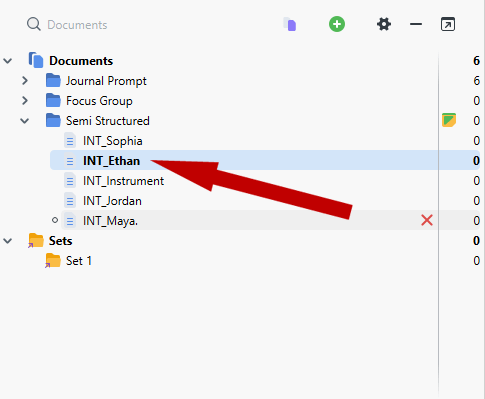
A short memo should be immediately written summarizing the context of the interview.
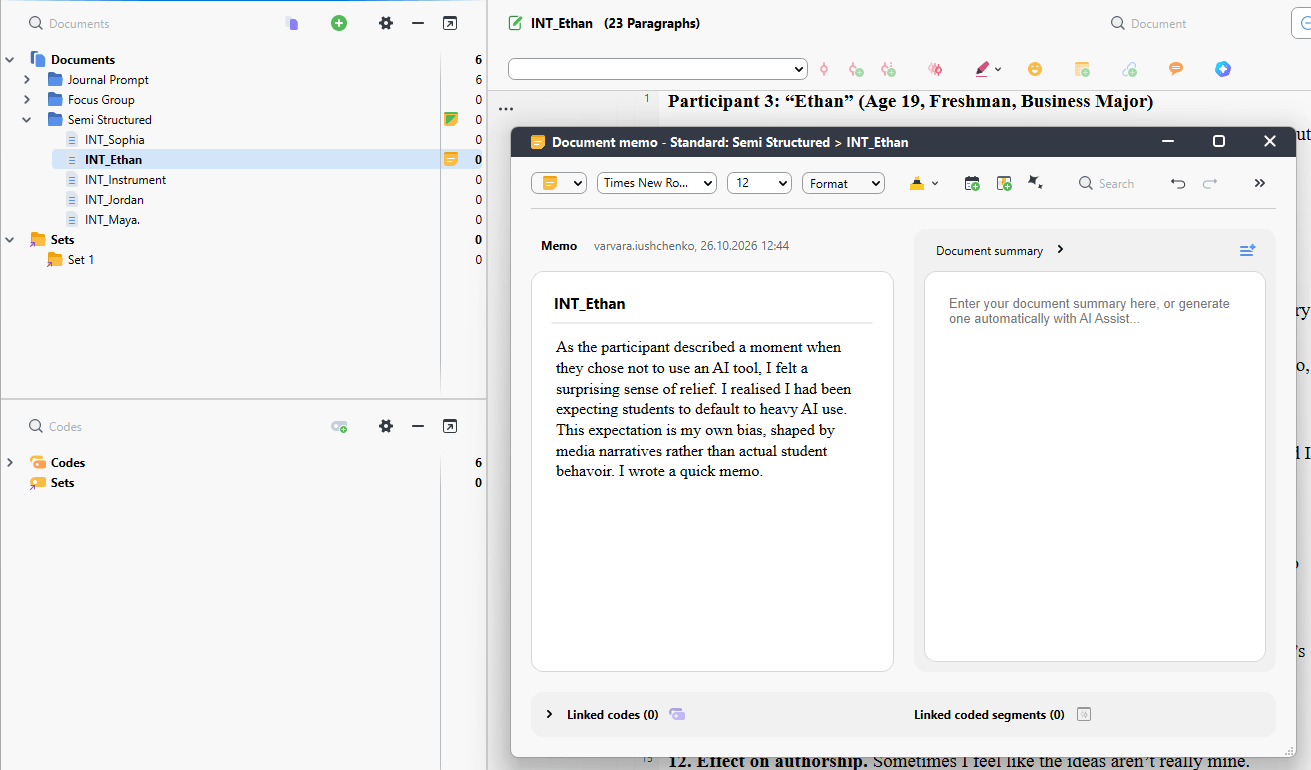
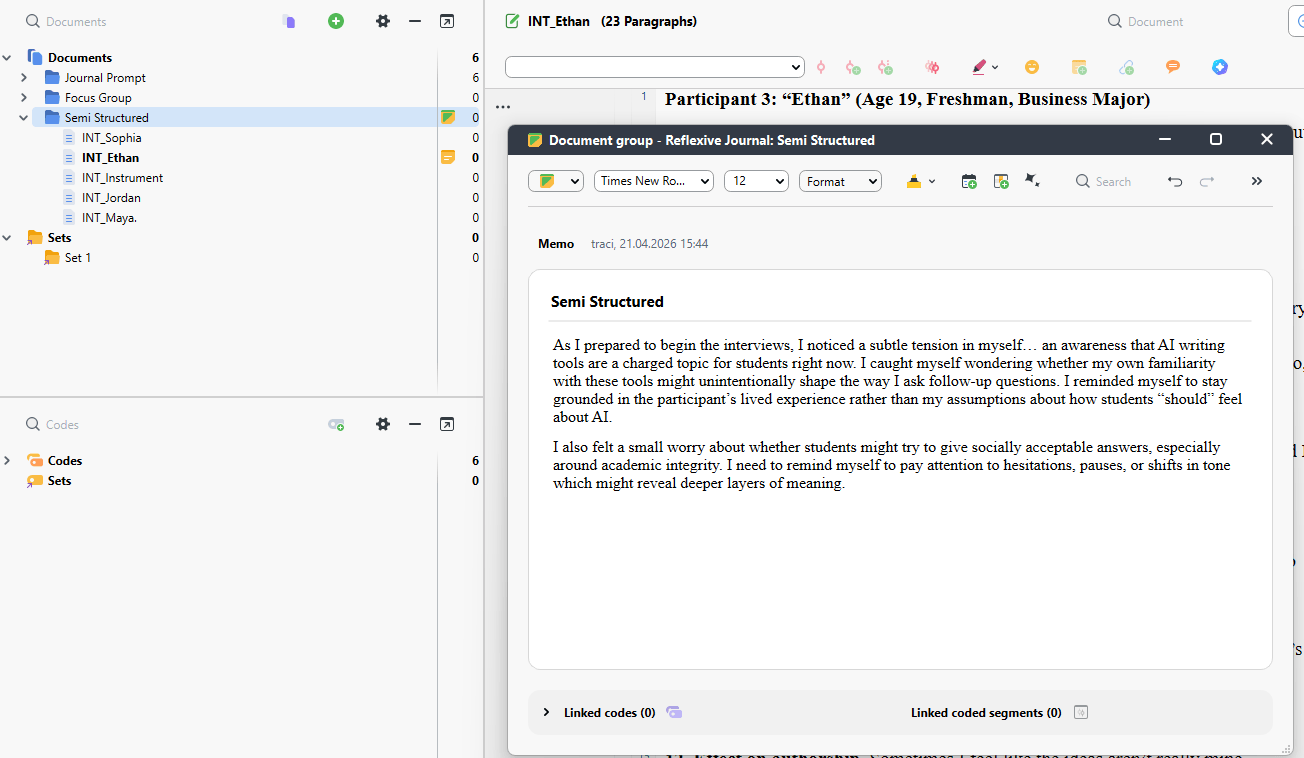
Before coding, read the entire transcript in MAXQDA’s Document Browser without touching any codes. Highlight passages that feel especially charged or revealing and write a reflexive memo attached to the document: what is noticed, initial reactions, any assumptions creeping in (e.g., “I’m already assuming over‑reliance is ‘bad’note”). This memo is part of the audit trail and an effort to bracketing any preconceived ideas.
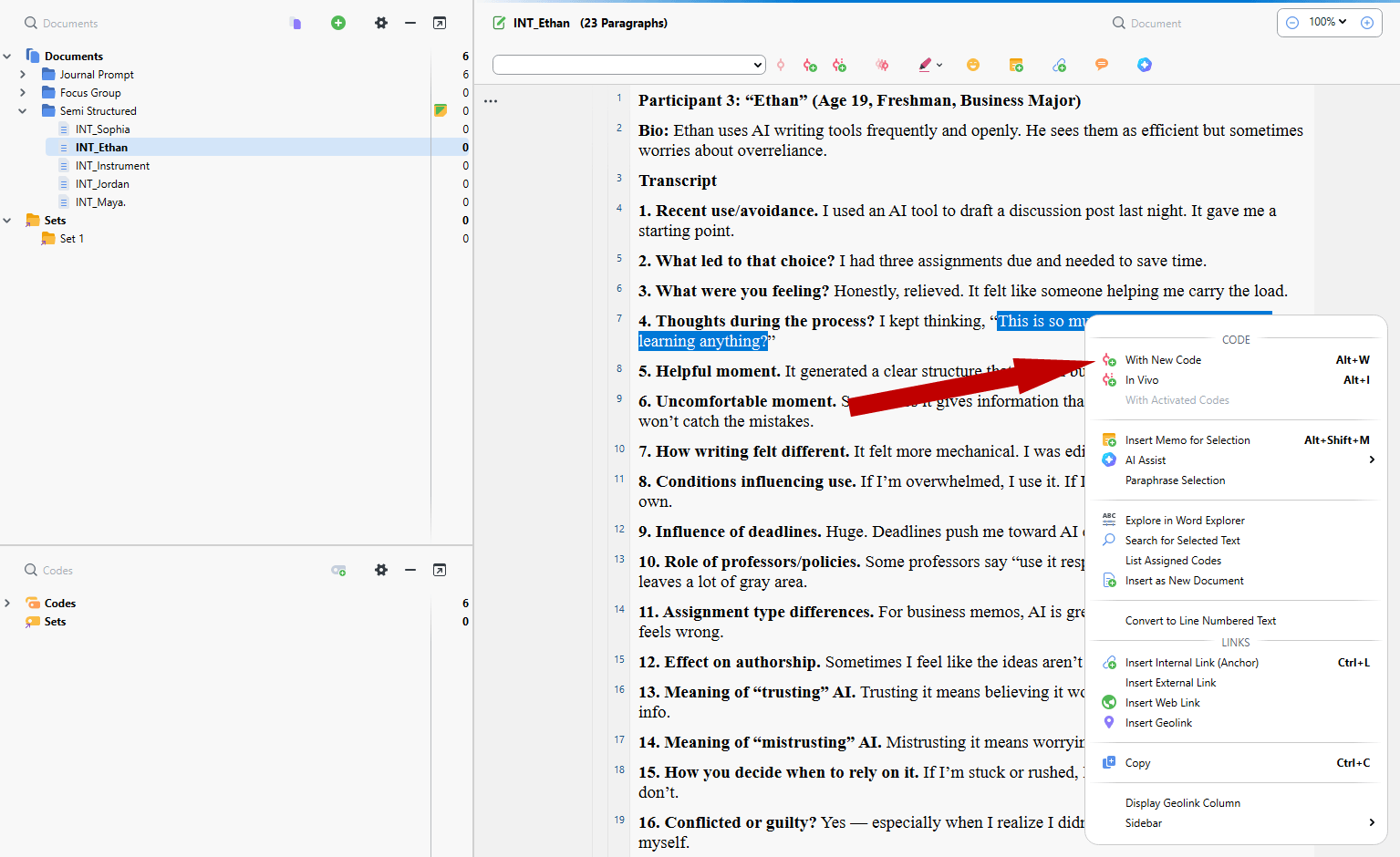
On the second pass, begin horizonalization: treating each meaningful statement as having equal value. In MAXQDA, use in vivo codes directly from the student’s words (e.g., “it doesn’t sound like me,” “I feel like I’m cheating,” “it saves me when I’m stuck,” “I’m just editing the bot”). Apply these codes line by line, creating many small, fine-grained codes rather than big conceptual buckets. Add short segment memos where needed to capture why a passage feels important phenomenologically (e.g., “strong emotional tone; relief mixed with guilt”).
Once the transcript is saturated (or provides the richness required) with in vivo codes, open the Code System and begin clustering. Drag related in vivo codes under emerging parent codes like Cognitive Tension, Guarded Reliance, Fear of Misalignment, Moral Ambiguity, Identity Disruption, Emotional Wavering. Use the Code Memo for each parent code to write a short, phenomenological definition grounded in the student’s language (not theory). Below you can see the parent code description for “Identity Disruption”:

The screenshot below shows how each window is populated with in-vivo segments, parent codes and how all are connected to the documents and each other.

Run a quick Code Matrix Browser (even with one case) to visually see where these clusters appear across the transcript. Look for where tension spikes, where moral ambiguity shows up, where identity disruption is most intense. These “clusters” represent the thematic development.
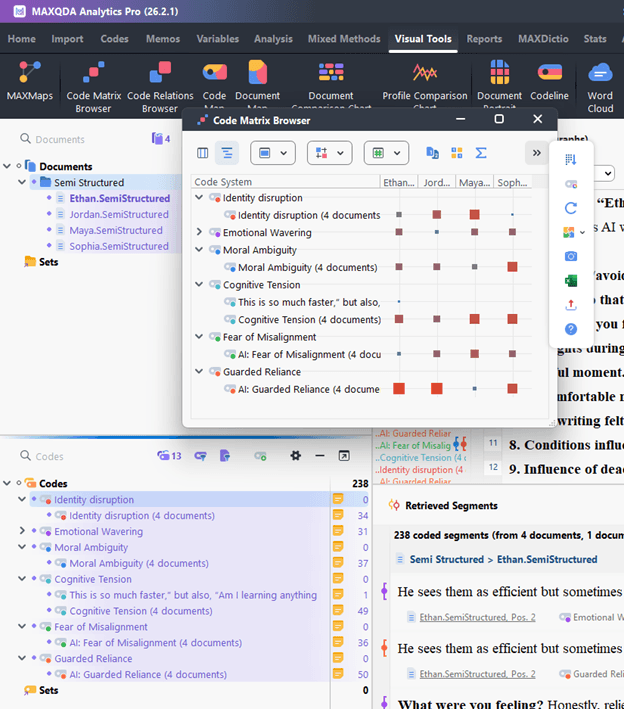
Next, move back and forth between codes and raw data. Use Retrieved Segments for each theme (e.g., all segments coded with Cognitive Tension) and read them as a whole. Refine code names and definitions so they better match the lived experience (e.g., changing “Trust Issues” to Guarded Reliance because the student both trusts and doubts). Add analytic memos that begin to articulate the “feel” of each theme: what it’s like to live that tension, that guardedness, that moral ambiguity. You’re still describing, not explaining. MAXQDA’s side-by-side view of codes and text keeps you anchored in the participant’s voice.
After this initial description, use the coded segments and memos to develop a textural description. Create a textural and structural group and immediately memo what each group means. Below shows the textural and structural groups:
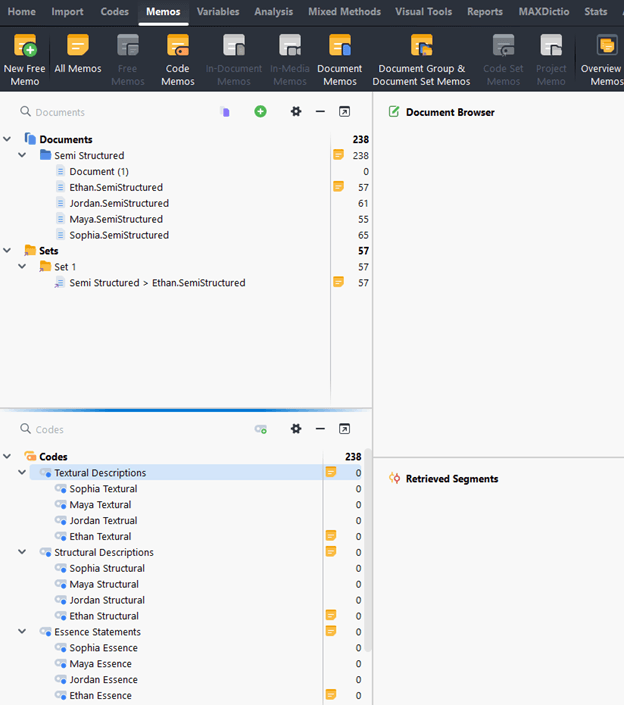
Open a Memo titled “Textural Description: Participant 1” and write a narrative of what the student experienced. Pull in verbatim quotes via copy-paste from retrieved segments, keeping them intact to preserve emotion and context. Describe the experience of using AI tools: the moments of relief, the spikes of guilt, the sense of “this isn’t my voice,” the feeling of being an editor instead of an author. Stay strictly descriptive. Do not use any causal language, introduce theory, and be careful not to explain why the participants feel or describe these experiences.
Here is an example in our hypothetical transcendental phenomenological study for Ethan’s textural description:

Once the textural description is complete, use imaginative variation to develop the structural description by shifting to how the experience unfolded. Re-read the same coded segments, now asking: under what conditions does this tension arise? When does guarded reliance intensify? What contexts (deadlines, high-stakes assignments, fear of being caught) shape the experience? In MAXQDA, create a new memo: “Structural Description: Participant 1.” Describe temporal, relational, and contextual structures: late-night writing sessions, pressure to perform, institutional expectations, the presence of AI as a silent “third party” in the writing process. Use variables (e.g., year in school, writing load) as prompts in your thinking, even though you only have one case here. Use the data to imagine different conditions and see what remains essential.
Here is an example of our hypothetical study of Ethan’s structural description:

Finally, the synthesis will start to take shape to develop the essence. Open both memos (textural and structural) and read them together. Create a new memo: “Essence: AI Writing Tools (Mini Case).” Develop the essence considering the actual coded data and quotes: the wavering between empowerment and unease, the vigilance, the disrupted authorship, the moral tension. Check each sentence of the essence against the data: “Can I point to segments that show this?” If not, you revise. MAXQDA’s memos, code system, and retrieved segments keep you honest. The essence must be traceable back to the participant’s words.
Here is Ethan’s essence memo:

Throughout the data analysis process, use Project Memos to log each analytic session (date, what you did, what shifted). Keep Reflexive Memos to note your own reactions to AI, your assumptions about “good” student writing, your feelings about academic integrity. Rely on MAXQDA’s automatic log of coding activity as part of the audit trail. By the end, a visible, defensible path from raw transcript to in vivo codes to clustered themes to textural and structural descriptions to essence will be traceable.
About the author

Dr. Traci C. Eshelman is an Assistant Professor and Certified Methodologist at Liberty University, where she teaches doctoral-level qualitative research methods and dissertation research. Dr. Eshelman is also a QDAS Trainer and Resident Transcendental Phenomenology Methodologist with MAXQDA, delivering workshops, training, and scholarly resources on phenomenological analysis and qualitative data analysis software. Her research interests include phenomenology, educational technology, AI governance in K-12 education, and the impact of artificial intelligence on writing, assessment, and critical thinking across educational settings from elementary school through doctoral education. She can be reached at Teshelman@Liberty.edu.
